Dr. Robin Dhakal is quick to say he does not know everything.
That humility is part of what makes him such an effective economics professor at the University of Arizona Global Campus (UAGC). Despite holding advanced degrees in economics, over a decade of higher-education teaching experience, as well as maintaining an active research and writing practice, Dr. Dhakal approaches teaching as an ongoing conversation.
“In a perfect day in class, I would love to have a healthy conversation among students where they are engaging with the course topics, but they’re also exploring others, bringing in their own interests and lived experiences. Those are the best kind of days.”
Conversations shaped as much by his students’ lived experiences and his own as by economic theory.
Dr. Dhakal is committed to breaking down complex ideas into concepts people can understand and use.
One of those concepts guides his teaching and decisions everyday: incentive.
“Incentive is one of the most important ideas in economics,” he explains. “When people understand incentives, they can make more empowered decisions about their lives.”
Economics, Everywhere
Consider this scenario: Panda Express is offering free samples at select locations. No strings attached.
Dr. Dhakal knows better.
Still, that did not stop him from driving more than half an hour to the nearest location with his wife happily in the passenger seat. The samples were free, yes, but as Dr. Dhakal predicted, they did not leave empty-handed. They walked out with full meals and a receipt.
“The incentive got us through the door,” Dr. Dhakal says. “The convenience got us to spend.” He paused, then added, “Also, if you knew my wife, you’d know I didn’t really have a choice.”
In a perfect day in class, I would love to have a healthy conversation among students where they are engaging with the course topics, but they’re also exploring others, bringing in their own interests and lived experiences. Those are the best kind of days.
Moments like these are how Dr. Dhakal experiences the world, through an economic lens that reveals the logic behind everyday decisions. He is passionate about challenging the idea that economics is dry, abstract, or disconnected from real life. He regularly reminds students that from the moment they wake up to the moment they go to bed, they are making hundreds of economic decisions, whether they realize it or not.
“I want students to see economics not as something they just have to get through,” he says. “It’s something they can take into the real world. Economics is everywhere.”
A Global Lens on Incentive
On top of his teaching, Dr. Dhakal writes regularly on his Substack, where he makes those connections tangible. He publishes essays on taxes, inflation, and economic policy. Some pieces are intentionally provocative, designed to fuel discussion and push students to think critically.
“My goal is to spark meaningful conversations and share useful ideas, with colleagues, students, and really anyone interested in economics,” he explains.
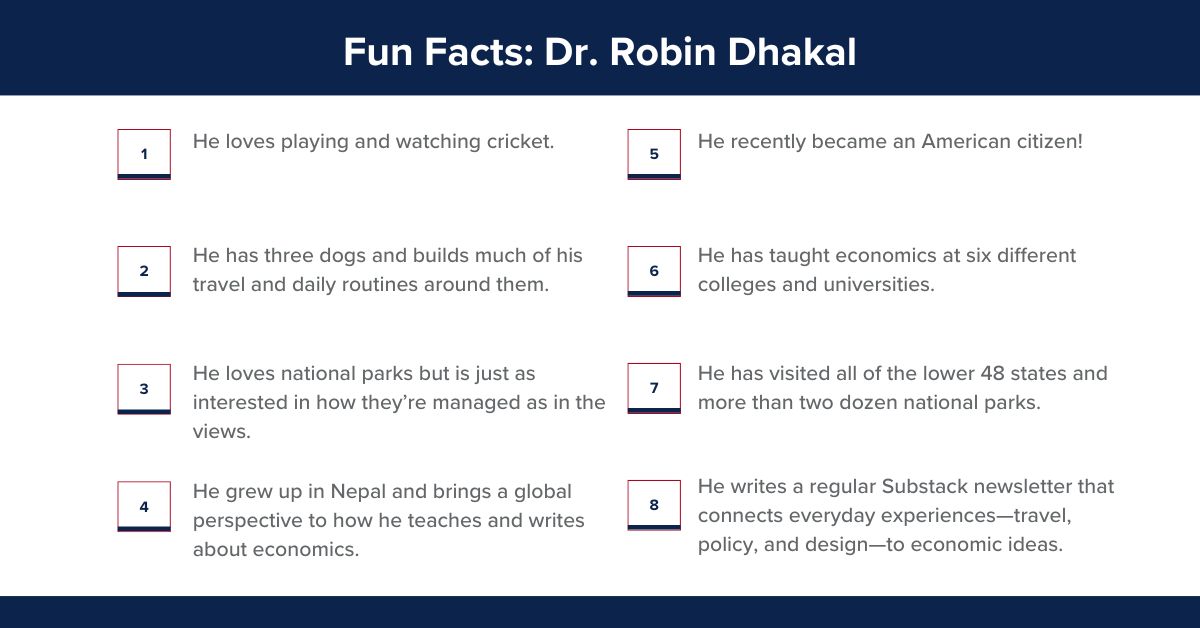
More recently, Dr. Dhakal’s writing has turned inward, back toward his homeland of Nepal.
During a recent trip, his second visit in 10 years, he found himself seeing the country from a different perspective. Familiar streets felt newly unfamiliar. Everyday systems revealed deeper patterns. Even leisure carried lessons.
While visiting a national park, Dr. Dhakal noticed the entrance fee for foreign tourists was $500, while Nepali citizens entered for free. The contrast was stark, and intentional.
“That difference is economics in action,” Dr. Dhakal said. “Incentive matters.”
The pricing structure influences who visits, how resources are protected, and how revenue circulates back into local communities. It encourages conservation while prioritizing access for residents.
“It’s not random,” Dr. Dhakal notes. “Those decisions shape behavior. They always do.”
For Dr. Dhakal, the moment reinforced why economic literacy matters far beyond the classroom. Economics, he believes, gives people the tools to see systems clearly, to understand why things are the way they are, and how policy choices ripple through everyday life.
Falling in Love with Economics (Twice)
Dr. Dhakal moved to the United States in 2006 in pursuit of education and opportunity. He attended Warren Wilson College, where he majored in mathematics and business economics, and where he fell in love. Twice.
The first time was with his wife. The other was with economics.
“When I was first introduced to economics, I really enjoyed it,” Dr. Dhakal recalls. “My professor took topics that could feel boring and tied them to real-world situations I could relate to. Suddenly, it made sense.”
That experience changed his trajectory. After graduating, Dr. Dhakal decided to pursue a Ph.D. in economics at the University of South Florida.
It was there that he stepped into the classroom for the first time, not as a student, but as an instructor.
Teaching Through the Nerves
At South Florida, Dr. Dhakal served as a teaching assistant, leading classes filled with peers not much different from himself.
“Some days were great,” he says. “Some days, I was just trying not to have a full-blown panic attack.”
But the nerves never outweighed the pull.
“Teaching doesn’t feel like something I’m ‘good at’ in a bragging sense,” he says. “It feels like something I can do in a way that helps students see and understand concepts more clearly.”
That clarity became his signature.
Dr. Dhakal quickly learned that no two classes, and no two students, are the same. His approach evolved into one that adapts to the room, pulls in real-world examples, and prioritizes relevance over rote learning.
“Taking a class doesn’t have to be something you just check off a list,” he explains. “When students feel that connection, everything changes.”
Teaching Where Access Matters Most

Now based in Florida, Dr. Dhakal has been with UAGC since 2022. He was immediately drawn to the institution’s nontraditional student population.
“That was the biggest motivator for me,” he says. “Many of our students are military or working professionals. They bring real experience into the classroom.”
That experience, he says, transforms the dynamic.
“There’s a different atmosphere,” Dr. Dhakal said. “The discussions are richer. I’m learning from my students as I teach.”
His role today is split between teaching and leadership and committee work, but teaching remains at the heart of it.
“I love the teaching,” he says. “100 percent.”
Making Economics Accessible
Dr. Dhakal does not claim to have all the answers. What he does claim, and what his students consistently experience, is an ability to explain complex ideas in ways that are clear, digestible, and relevant.
At minimum, he believes every student should take at least one economics course.
“Even if someone doesn’t pursue a full degree,” he says, “having some exposure to economics helps people make sense of the world.”
Through teaching, writing, and open dialogue with students, Dr. Dhakal continues to pursue a simple goal: helping students see economics not as an obstacle, but as a tool that is practical, empowering, and rooted in everyday life.
Get to know Dr. Dhakal
UAGC: A misconception students have before taking your class is …
Dr. Dhakal: "That economics is dry, boring, and hard."
UAGC: A moment in class that made you stop and think, this is why I do this, is …
Dr. Dhakal: When students go beyond what they were asked. There might be a discussion question focused on something very specific, but students will use their analytical and critical thinking skills to expand the conversation into related ideas. Seeing them connect the dots on their own, that’s when it really clicks.
UAGC: Your teaching style is best described as …
Dr. Dhakal: Conversational. It’s not a democracy, and it’s not a dictatorship, it’s an exchange of ideas. I want students to feel comfortable engaging, questioning, and contributing to the discussion.
UAGC: The question you love when students ask is…
Dr. Dhakal:“How does this help me?” When students understand the models and theories but want to know how they apply to their own lives, that tells me they’re really engaging with the material.
UAGC: Your dogs would describe me as …
Dr. Dhakal: Someone who loves the outdoors. I take them out every day for long walks, at least two to three miles, so I think they’d say I’m happiest outside.
UAGC: A lesson I’ve learned from my students is …
Dr. Dhakal: To be open-minded. They’ve taught me how important it is to be a lifelong learner. I know it sounds cliché, but I genuinely believe it. I love going into the classroom and learning from my students.
UAGC: Describe economics in three words.
Dr. Dhakal: Economics is everywhere. From deciding what to eat for breakfast to how you organize your time, every choice you make is an economic decision. Opportunity cost matters. Every choice involves a trade-off, if you choose one thing, you’re giving something else up. It makes you a more wholesome person. Economics gives you the tools to dig deeper into news and current events, so you’re not just accepting talking points or propaganda, you’re asking better questions and trying to understand what’s really going on.