Key Takeaways
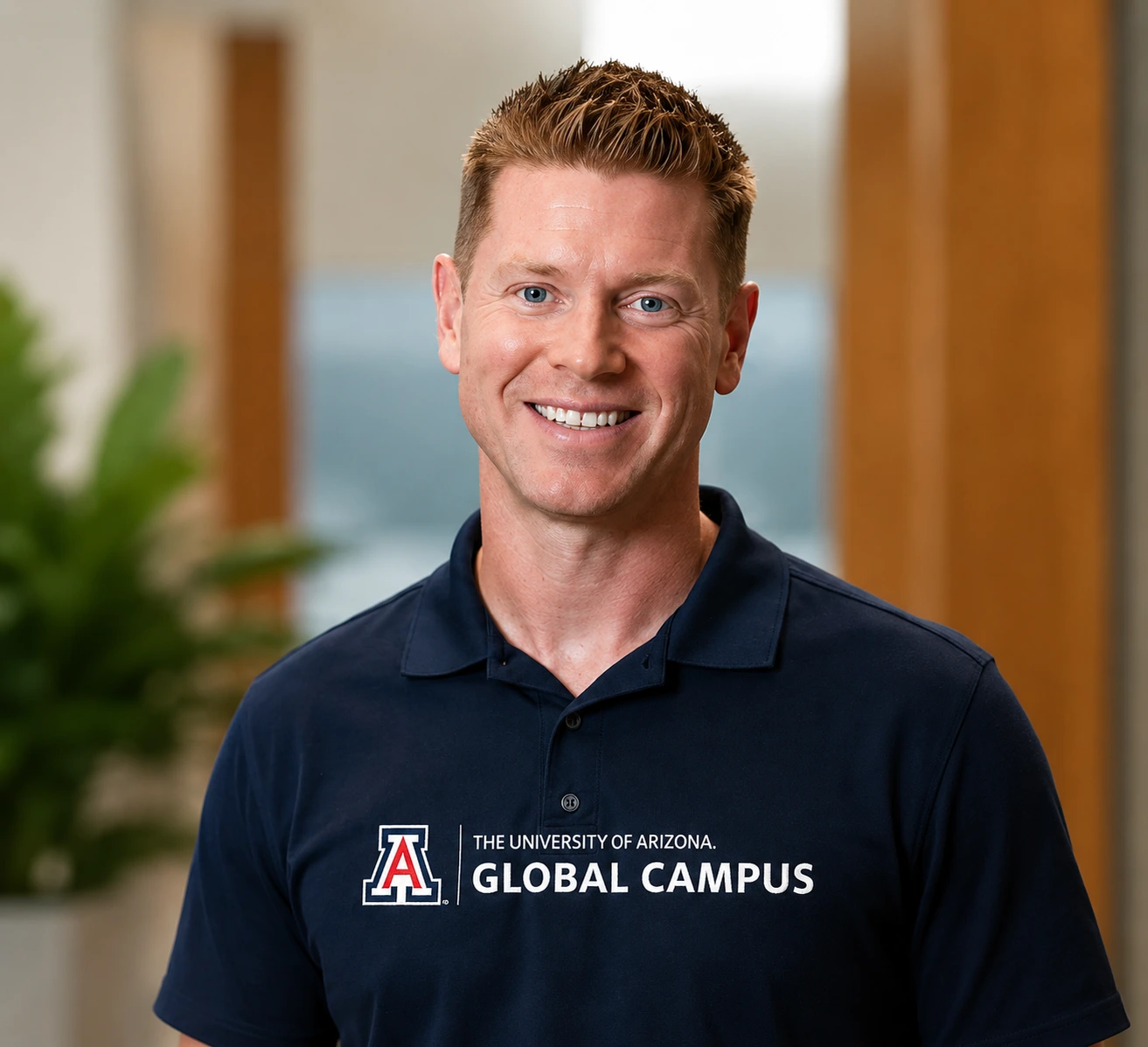
- The University of Arizona Global Campus (UAGC) alum Erik Baker earned his BA in Education Studies in February 2026.
- Erik has served as a firefighter in Mississippi for more than 20 years.
- Encouraged by his wife, an educator, Erik pursued his degree to expand the impact he could make in his school district.
- After retiring from the fire service, Erik plans to transition into teaching.
- Erik credits the flexibility and support at UAGC for helping him balance work, family, and earning his degree.
- Throughout his career, Erik has been driven by a passion for serving, leading, and supporting others — values he plans to carry into education.
- Erik’s story shows that it’s never too late to pursue a new career path, and that embracing change can be an opportunity to answer a new calling.
--
UAGC Alum Erik Baker is Answering a New Call
The fire engine is still cooling when Erik Baker steps away from the truck. Inside the station, the radio crackles with the next dispatch, boots line the floor by the door, and a half-finished report sits open on a shared computer terminal. Somewhere between calls, urgency, and routine, the University of Arizona Global Campus, then student, Erik finds a quiet moment to open another assignment for his education degree.
It is an ordinary scene in this Mississippi firehouse. For Erik, it represents something larger: a life lived between two callings.
One is nearly two decades long: firefighter, responder, protector.
The other is just beginning: educator, mentor, role model.
In Mississippi, where public education has made measurable gains in recent years but continues to wrestle with long-standing challenges in equity and representation, that second calling carries particular weight. Educator vacancies continue to rise. That gap was not an abstract statistic to Erik, who grew up in Hattiesburg. It was a conversation at home that refused to fade.
His wife, Celeste, an educator with two master’s degrees, often spoke about students who needed to see themselves reflected in the adults guiding them, about young boys growing up without consistent male figures in schools or at home, about the difference one teacher, one mentor, one steady presence could make.
Those conversations did not ask him to become someone new. They asked him to consider where else he might serve. From truck driver to firefighter to earning his Bachelor of Arts in Education Studies,* Erik is preparing to answer his next call.
A Degree Deferred
Long before he ever considered a career in education, Erik had built a life around helping people. Before the firehouse, there was the highway.
“I’ve always had the spirit of helping people,” he says. “Even driving an 18-wheeler for 10 or 12 years, I’d see accidents and stop. I’d get out and help. It was just in my nature.”
That instinct eventually pulled him into firefighting, where he spent more than 20 years serving in Gulfport, Mississippi.
“I said, you know what? I’m going to throw my hat into be a fireman, and that’s where I stuck,” he says. “And I did well with it.”
Firefighting gave structure to what trucking had already revealed: a man who did not pass by crisis but moved toward it. Yet even as he built a long career in emergency response, another part of his life remained unfinished.
In 2010, he enrolled in college with a simple goal.
“I was just going to try to get my associate degree,” he says. “Honestly, I wasn’t really committed to a bachelor’s at that time.”
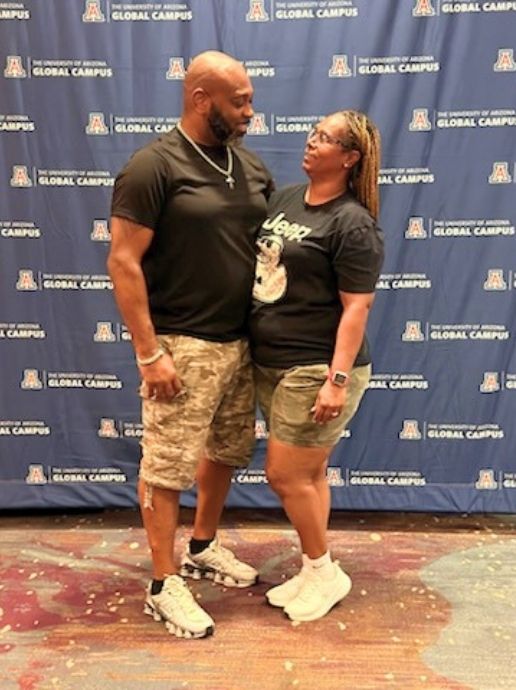
Life in the fire service was already demanding. Special assignments, training cycles, and long hours made school feel like an additional responsibility rather than a priority. The first two semesters went well. Then momentum slowed.
“I started getting more and more involved in the fire department,” he says. “I had progressed, I had ranked up, and it kind of threw education to the wayside.”
The degree was not abandoned. It was deferred — quietly, indefinitely. Years passed.
By 2022, life had become even more complex. He was working with two fire departments, one full-time, one part-time, while also training and instructing others in the field. It was then that his wife intervened, not with pressure, but with perspective.
A seasoned educator, Celeste had spent her career inside classrooms and school systems that too often lacked teachers and Black male representation. She saw firsthand what that absence meant for students. And she saw what Erik could bring. So, she pushed him to try for his degree again. And not his associates but his bachelor’s.*
“My wife said, ‘If you’re going to do it, do it; go for the gusto. Get it all,’” he recalls.
What had once been “finishing a degree” became something larger: preparing for a second act in education.
“After years of serving as a firefighter, I realized I wanted to continue making a difference by educating, mentoring, and leading others,” he explains. “School gave me the opportunity to do that while balancing work, family, and everything else.”
He enrolled at UAGC and started over.
Learning How to Learn Again
Returning to college after years away was not seamless.
“The first semester was pretty rough,” he admits. “I had to get reacclimated to writing papers, getting things done on time … just everything.”
Even basic academic writing felt unfamiliar at first. That is where his wife stepped in again.
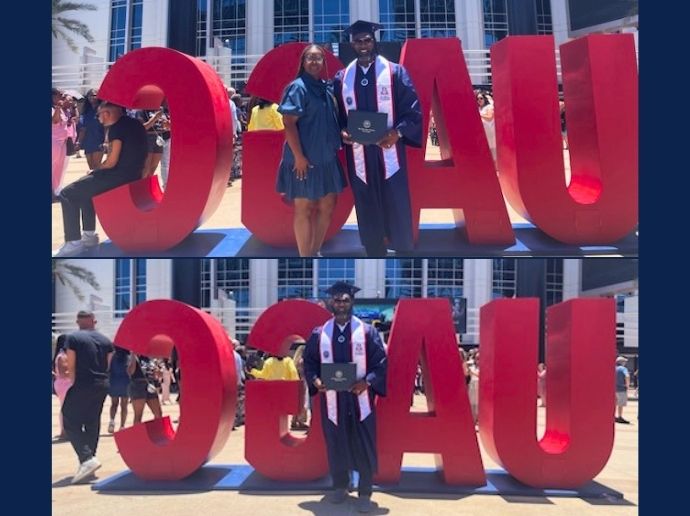
“Celeste was a great support,” Erik says. “I relearned how to write papers through her.”
She guided him through structure, clarity, and revision. At first, he leaned heavily on her feedback. Then something shifted.
“She told me, ‘You’re going to stop needing my advice, you’re going to learn,’” he says. “And she was right. I started writing more and more, five-, six-, even 10- or 12-page papers.”
Confidence followed repetition.
“Four years later, here I am,” he says.
What changed most was not just his ability to write but his belief that he could succeed in an academic space he once assumed was behind him.
“I started seeing As and Bs,” he says. “And I was not an A or B student in high school. Not at all.”
The Firehouse Classroom
If his wife helped him succeed at home, his firehouse helped him survive the grind. Assignments were often completed between calls while using shared station computers with limited access and unpredictable interruptions.
“I couldn’t take my laptop on calls,” he says. “Sometimes I had to just do the bare minimum to get coursework started.”
But his colleagues understood.
“My brotherhood at the station was awesome,” he says. “They helped me out a lot.”
Sometimes that meant encouragement. Sometimes it meant something more practical: space and time. When possible, firefighters covered responsibilities or allowed him to remain at the station during lower-level calls so he could complete assignments. They knew what he was working toward, even if it meant he might eventually leave the profession they shared.
“They supported me anyway,” he says. “Even knowing I would be gone one day.”
That support mattered most during the final stretch.
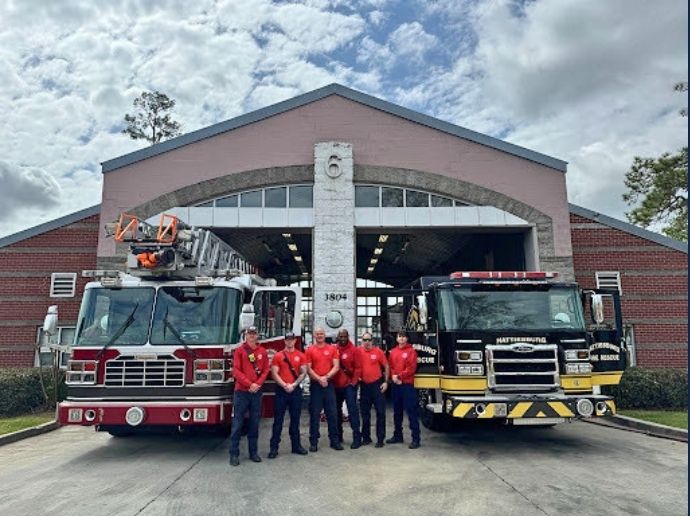 “Those last three or four months were a crunch,” he says. “Work, home, school, everything at once. But that was my put-up-or-shut-up time.”
He got through it with strong grades. Over time, something subtle but important changed. Erik stopped seeing himself as someone returning to school. He started seeing himself as someone succeeding in it. Someone who could actually run the classroom.
“My confidence grew big time,” he says. “Especially when I saw those grades.”
In the fire service, he already understood responsibility, communication, and precision. School sharpened those skills.
“We write reports for every call,” he says. “School helped me be more precise, better at punctuation, better at communication. That carries over into everything we do.”
Even writing itself became easier.
“I enjoyed my literature classes,” he says. “Math was a little tougher, but I had great instructors. If you reached out, they were always there.”
Each semester became less about survival and more about momentum. And when graduation came around, it represented a transition he still struggles to fully process.
“This is a big deal,” he says. “I never thought I’d finish a degree in my lifetime. Never thought I’d be walking across that stage.”
A New Classroom Ahead
In the coming weeks, Erik will retire from firefighting after more than 20 years of servic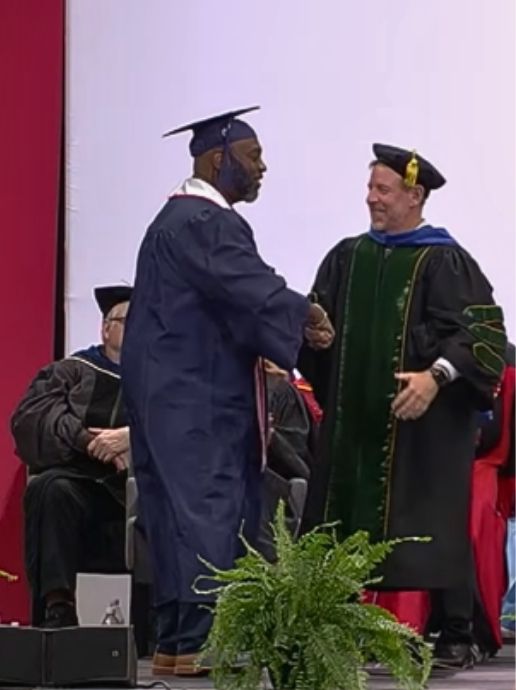 e. But even after stepping away from the fire engine for the last time, the work that has defined him is not ending; it is changing shape.
As he prepares this next chapter, Erik is working toward completing the alternate route requirements needed to become a certified teacher in Mississippi. His next steps include fulfilling the state’s licensure requirements, including required testing and completion of an alternate route program and internship, as he continues building the foundation for a career in the classroom.*
Erik is excited for the day when he’ll stand in front of students who are still learning how to find their voice, their direction, and their place in the world.* Some will already believe in themselves. Others will need someone to believe in them first. That is where he sees his role.
“Representation is not a concept talked about in meetings or measured in reports,” Erik says. “It is something lived out in real time. I’m a man’s man and a reminder that possibility is not limited by where you start.”
Looking back, he doesn’t point to one moment that carried him through. He points to people. A wife who helped him rebuild confidence and who is still walking beside him now as he studies for the Praxis exam.*He also points to the firehouse that made room for him to grow into something beyond the job he already knew. And to a belief — strengthened over time — that change is still possible, even after decades in one profession.
“Embrace it,” he said. “What you put into it is what you get out of it. You make time for what matters, and you let go of what doesn’t help you move forward.”
Thinking about starting a program? See our online degrees and chat with an advisor.
--
*The Bachelor of Arts in Education Studies is not designed to meet the state educational requirements for teacher licensure or certification in any state. Students seeking teacher licensure shall carefully research their state's requirements prior to enrollment and regularly review the requirements as they are subject to change. Requirements vary by state. Graduates will be subject to additional requirements on a state-by-state basis that will include one or more of the following: student teaching or practicum experience, additional coursework, additional testing, or, if the state requires a specific type of degree, earning an additional degree. None of the University of Arizona Global Campus online education programs are accredited by the Council for the Accreditation of Educator Preparation (CAEP), which is a requirement for certification in some states. Other factors, such as a student’s criminal history, may prevent an applicant from obtaining licensure, certification, or employment in their field of study.