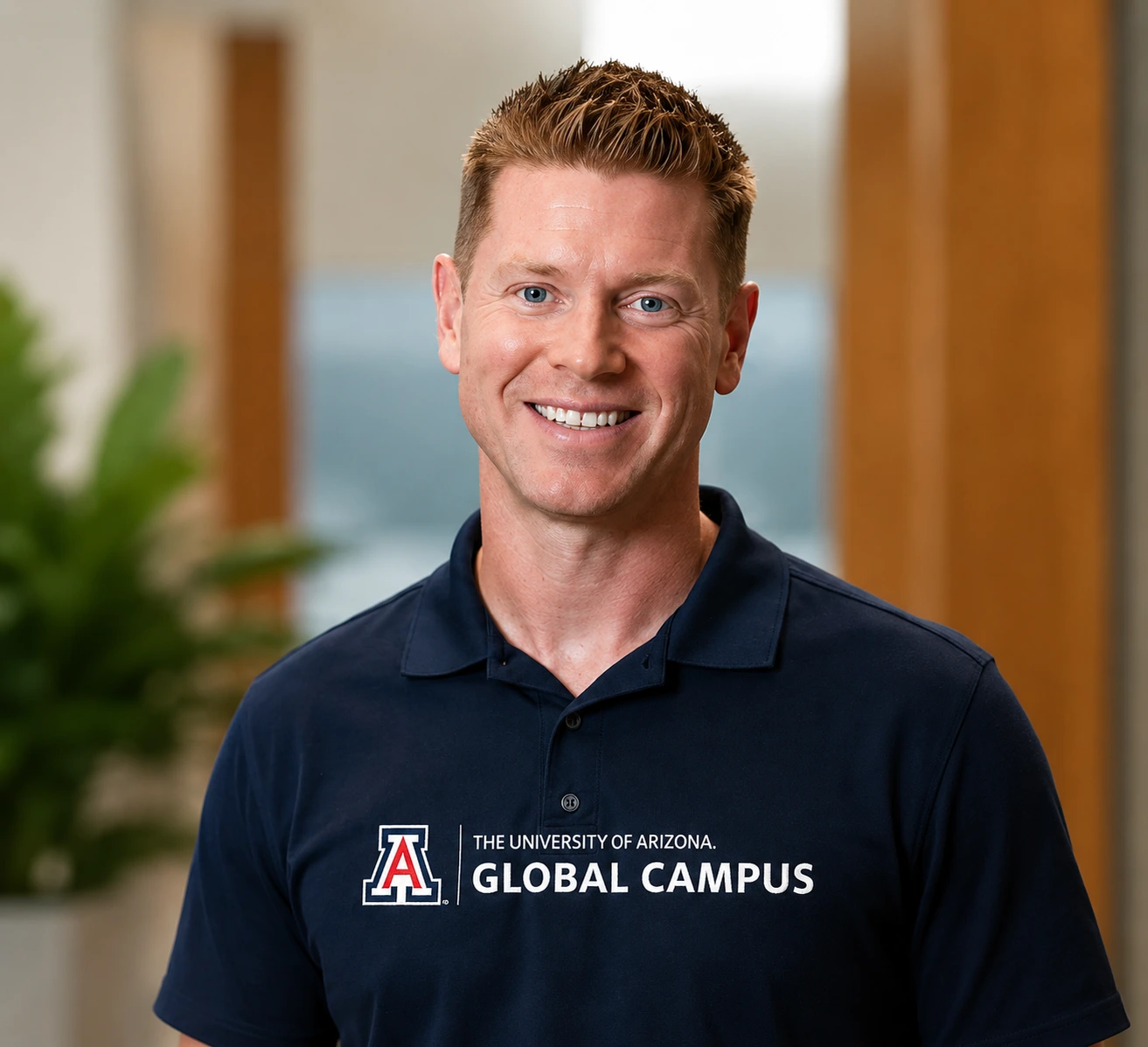
Key Takeaways
- This blog features Dr. Cheri Ketchum, Lead Faculty, Department of Communication and Humanities at the University of Arizona Global Campus (UAGC).
- Influential instructors helped Dr. Cheri Ketchum see possibilities for her own future, shaping her path from photography student to communication scholar.
- Dr. Ketchum teaches students to look at everyday experiences through new perspectives and apply communication strategies to their lives.
- Rather than accepting assumptions, students are challenged to examine how they formed their beliefs and what might change them.
- Strong opinions require evidence, research, and engagement with credible sources.
- Dr. Ketchum prompts students to ask how someone knows what they claim to know and whether the evidence warrants trust.
- She hopes students leave with the ability to operate their own “spotlight,” examining different ways of seeing and choosing how they engage with the world.
Understanding Influence: How Dr. Cheri Ketchum Helps UAGC Students See Differently
In an alternate universe, Dr. Cheri Ketchum is a sports photographer for the San Francisco Giants.
She is somewhere along the field or tucked in the crowd, camera in hand, waiting for the split second when everything comes together: a pitch, a swing, a slide, a celebration. Her job is to anticipate the moment before it happens and decide exactly how to capture it.
The photograph then becomes the story. What she frames is what people see.
“I always thought being a photographer or videographer for the San Francisco Giants would be a dream job,” Dr. Ketchum confesses. “Honestly, it still sounds like a great job to me. I’m almost kicking myself for not doing it.”
That very well could have been her reality. Before becoming a communication scholar and faculty member at the University of Arizona Global Campus (UAGC), Dr. Ketchum began her undergraduate studies by taking photography classes.
Her instructor took his students into the world, leading photography tours from Yosemite National Park to Ireland, where Dr. Ketchum spent five beautiful days developing her skills and broadening her perspective. Her instructor was among the first people in her life to help her see possibilities she had not yet considered for herself.
“He was willing to be a kind of guidance counselor,” she says. “He was also a very curious person; someone invested in the lives of his students. It was very clear to me that I'd never had an instructor like him before. He was an instrumental person in my life.”
When Dr. Ketchum told him she dreamed of traveling with the Giants, he encouraged her to pursue her education at San Francisco State University.
There, her lens changed. She started classes that were much more intellectual than practical or hands-on.
“It wasn’t photography, but I found myself very interested in this new focus on the theoretical and social elements of communication.”
This time, she crossed paths with another instructor who noticed her work and encouraged her to continue her education.
She listened. First came a bachelor’s and master's degree at San Francisco State University. Then, her academic path led her to the University of California, San Diego, where she earned a PhD in Communication with a specialization in Communication as a Social Force.
Looking back, Dr. Ketchum is grateful for the influence those instructors had on the direction of her life. They didn't just teach her information. They introduced her to new ways of seeing what was possible.
That idea has become a cornerstone in the way she teaches.
Teaching the Power of a Different Lens
The classes Dr. Ketchum teaches at UAGC most frequently include persuasion, intercultural communication, and communication in conflict. Though each explores a different area of communication, they share a common purpose: helping students develop new ways of understanding the world around them.
She wants her students to understand that strategic communication is not something that exists only inside a classroom. It is happening constantly — in relationships, workplaces, communities, and the decisions people make every day.
“All three of those classes are relevant to everyone's existence,” she says. “They all provide a different set of lenses through which to see the world around them and then very practical sets of strategies they can try out or change in their lives.”
Her scholarship has continued to examine the relationship between communication and the human experience. Through University Fellows Program grants, she has contributed to research exploring what students want from interaction and engagement in an online learning environment. She has also written about video feedback and the importance of ePortfolios in demonstrating student learning competencies.
“UAGC changes lives with the opportunity to earn a degree,” Dr. Ketchum says. “I want to compound that and change lives by putting spotlights on different ways of seeing. Hopefully, teach them the skill of operating that same kind of spotlight.”
For Dr. Ketchum, that is where education becomes especially powerful. A new lens can change what someone notices. A new media type can help better digest feedback. New knowledge can change what someone believes.
“And a well-supported argument can change what one accomplishes in life or even leads to broader social change.”
But that last part comes with responsibility.
Before You Persuade, Learn
Dr. Ketchum pushes students to examine the foundations of their own ideas before asking anyone else to accept them. In her classroom, having an opinion is only the beginning.
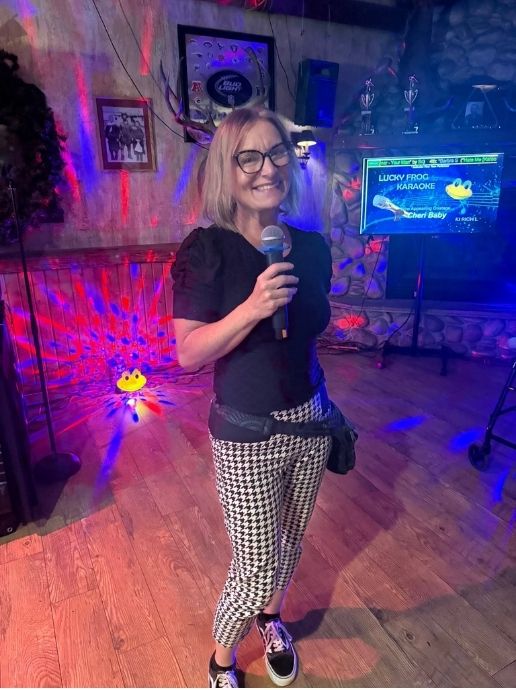
for the next class, you could find her
singing her heart out at a karaoke club.
“In a scholarly environment, an academic environment, you gain your credibility to speak by engaging with other experts,” she explains. “You're not there to just say what you think. That's just not the way scholarship works.”
Research isn't simply an academic requirement. It is the foundation of trust.
“It is the building block for me being able to trust what you say,” she adds. “You need to show me that you informed yourself and that you spent time. You need to show me who taught you whatever it is you know.”
That process asks students to do more than collect sources. They must understand them, represent them accurately, and explain how those sources inform their own thinking.
It is a lesson about persuasion but also about intellectual humility. Before trying to change someone else's mind, you have to be willing to examine your own.
“The more you can do that, the more I can trust that you thoughtfully thought through what you say,” she concludes.
Learning to Be Skeptical
Dr. Ketchum considers skepticism one of the most important skills she can teach.
“I'll say this outright: one of my main goals is to teach people to be skeptics,” she says. “My goal for my students is to make assessing credibility a general skill.”
That skill transcends academic writing. It applies whenever someone makes a claim, including when the person making the claim is the student themselves.
“How do they know what they know?” Dr. Ketchum asks. “How are they showing me they know what they know? And can I trust that information?”
In other words, don't simply ask whether you agree. Ask why you believe. Then ask what would cause you to reconsider.
Dr. Ketchum describes her approach to teaching as an excavation. If a student says they support a particular position or idea, she wants them to dig beneath the surface.
“If you say you support this policy or that, and then you don't have much to say about why, I'm going to push you to think through it,” Dr. Ketchum says. “We're always digging. Then we dig further.”
That digging is part of what makes persuasion meaningful. A persuasive argument is an opportunity to demonstrate that an idea has been examined, tested, and thoughtfully constructed.
“I'll say this outright: one of my main goals is to teach people to be skeptics,” she says. “My goal for my students is to make assessing credibility a general skill.”
One strategy Dr. Ketchum uses to help students develop that skill is the Toulmin model of argumentation: claim, evidence, and explanation.
“You're not going to walk into a courtroom, for example, and fight your case without evidence,” she says. “In that same manner, you have to fight for your opinions.”
This strategy is more than helping students write stronger arguments for a course paper.
“I want to create more thoughtful, informed human beings who can operate in this world in a way that both allows them to achieve their personal goals and also be aware of the social implications of what they're doing,” Dr. Ketchum explains.
When a New Perspective Changes a Life
Sometimes the impact of the work Dr. Ketchum dedicates in and out the classroom becomes visible.
Before working at UAGC, she worked for a labor union as a Research Analyst. She helped find information and develop campaigns to support current and prospective members.
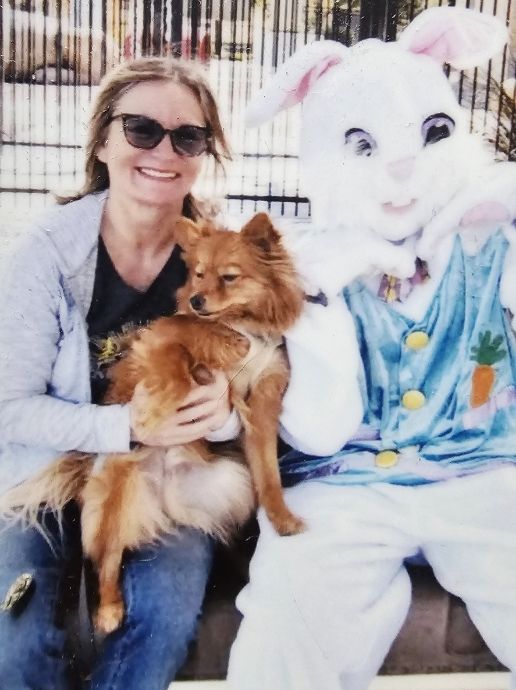
posing with the Easter Bunny.
“It was interesting work,” she noted back in 2024, “as I learned about how power operates, both within and between organizations in conflict. That was a precursor to, and a good set-up, for teaching Communication and Conflict.”
Her experiences culminated at a UAGC spring commencement ceremony. A student from one of her classes went out of her way to find Dr. Ketchum in person.
The student told her that she had hoped to meet her because the class had been personally profound and had changed the way she thought.
The class was Communication in Conflict.
The moment was especially meaningful to Dr. Ketchum because she had taught the student only once. But perhaps that is precisely the point.
Influence does not always require years of personal interaction. Sometimes, one idea introduced at the right moment can become a new perspective through which someone views their life.
“That was the goal, right?” Dr. Ketchum says. “I told you that I want to change people's lives.”
She distinguishes earning a degree from changing the way someone examines the world.
“UAGC changes lives with the opportunity to earn a degree,” Dr. Ketchum says. “I want to compound that and change lives by putting spotlights on different ways of seeing. Hopefully, teach them the skill of operating that same kind of spotlight.”
The Responsibility of the Spotlight
Something is fitting about a former photographer teaching persuasion. A photographer chooses the frame. A communicator chooses the argument. Both require attention to what is visible and what might be overlooked. But Dr. Ketchum's teaching philosophy goes one step further.
“I want to create more thoughtful, informed human beings who can operate in this world in a way that both allows them to achieve their personal goals and also be aware of the social implications of what they're doing.”
She does not want students to just accept a new perspective. She wants them to learn how to examine the perspective itself.
In an alternate universe, Dr. Ketchum might still be standing on the sidelines at a Giants game, waiting for the perfect moment to press the shutter. In this one, she is still working with a camera. Only now, the focus is the mind.
If you are thinking about building your skills in writing, persuasion, and communications or exploring a career in liberal arts, explore our degree programs today and speak with one of our academic advisors.
Quick Q&A: Life Beyond the Classroom
UAGC: What brings you joy that's completely unrelated to your career?
Dr. Ketchum: “I play pickleball three-to-five-times a week and have been in leagues and tournaments. I also do karaoke two-to-four-times a month.”
UAGC: What's the best meal you make?
Dr. Ketchum: “I make a very good vegetable lasagna and pad thai.”
UAGC: What's one thing your coworkers or classmates would be surprised to learn about you?
Dr. Ketchum: “I have very deep roots in California, going back thousands of years. My great-great-grandmother was the last person to speak the native language of the Amah-Mutsun tribe, near Gilroy, California. There is a statue of her at the San Juan Bautista mission and a school named after her in Gilroy.”
UAGC: What is one thing on your bucket list?
Dr. Ketchum: “Going on an African safari.”
UAGC: What would your 18-year-old self think if they met you today?
Dr. Ketchum: “She would be impressed and surprised that I live in Las Vegas. She would probably tell me to move back to California, and her advice might be sound.”
UAGC: If someone wrote a chapter about you, who would deserve a chapter of their own?
Dr. Ketchum: “As mentioned in my longer interview, two college professors were instrumental to my journal - Rich Murai (a photography instructor) and Michelle Wolf (a media studies scholar).”