Key Takeaways:
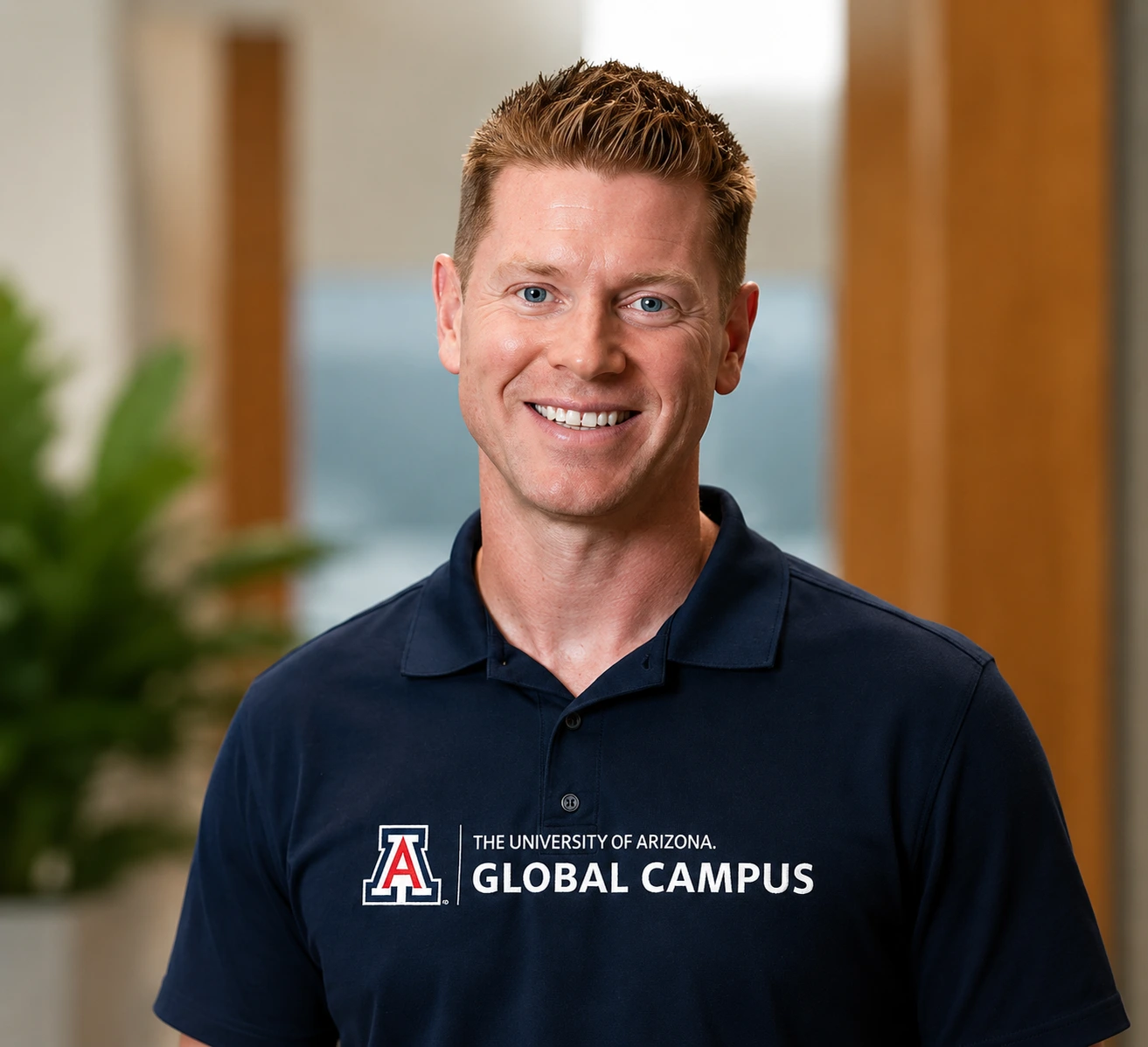
- This blog features Dr. Josh Herron, Lead Faculty in the Department of Applied Scholarship in the College of Integrative Learning at the University of Arizona Global Campus (UAGC).
- Dr. Herron sees today’s AI debates as part of a longer history of educators adapting to new tools, from writing to mobile technology.
- He explains why technology should expand possibility without replacing the relationships, meaning, and collaboration that make learning valuable.
- His work demonstrates how emerging technology can support diverse learners and help more people see themselves as capable contributors when used thoughtfully.
- Dr. Herron draws from his own first-generation college experience to design learning practices that help students recognize their growth and potential.
- His work in instructional design proves that effective online learning connects students to themselves, their peers, faculty, and the fields they are preparing to enter.
- Dr. Herron encourages educators and students to remain curious, intentional, and hopeful about what they can create with emerging tech.
--
Dr. Josh Herron’s Vision for the Future of Learning
Every generation of educators has had to deal with what happens when new technology changes how people learn.
The internet changed how people accessed information. Mobile devices put computers in students’ pockets. Now, generative artificial intelligence, or AI, is challenging assumptions about everything from how students complete assignments to how they develop critical-thinking skills.
In September 2026, New York City responded to that challenge with a one-year moratorium on student-facing generative AI for students in 2-K through eighth grade. The policy also introduces AI literacy modules for high school students and limited, teacher-supervised AI pilots. The goal, according to city officials, is to protect human connection while giving students the skills to navigate a world increasingly shaped by AI.
For Dr. Josh Herron, faculty member at the University of Arizona Global Campus (UAGC) whose work has spanned teaching, instructional design, mobile learning, online education, and academic administration, the conversation is bigger than whether a particular technology belongs in a classroom
“I typically am not a fan of broad mandates like that,” he says. “I think it's a more contextualized question of when and where and how a technology is involved. It is about what happens when technology changes the way we work, learn, and connect — and how educators can make sure people remain at the center of that change during the integration.
“Any broad mandate that says we’re gonna not use this technology misses the mark of what’s possible,” he says.
He has observed versions of this conversation before. In his doctoral research at Clemson University, Dr. Herron explored mobile learning, tracing it back to how humanity’s shift from an oral society to a written one changed how people learned and remembered information. Today, he sees a similar transformation unfolding with technology.
Across his career, Dr. Herron has learned to embrace what new technologies make possible while remaining grounded in what technology cannot replace: human connection, curiosity, and the transformative power of learning. At UAGC, he continues that work, helping students navigate what’s next without losing sight of the people at the heart of education.
Keeping Humans in the Conversation
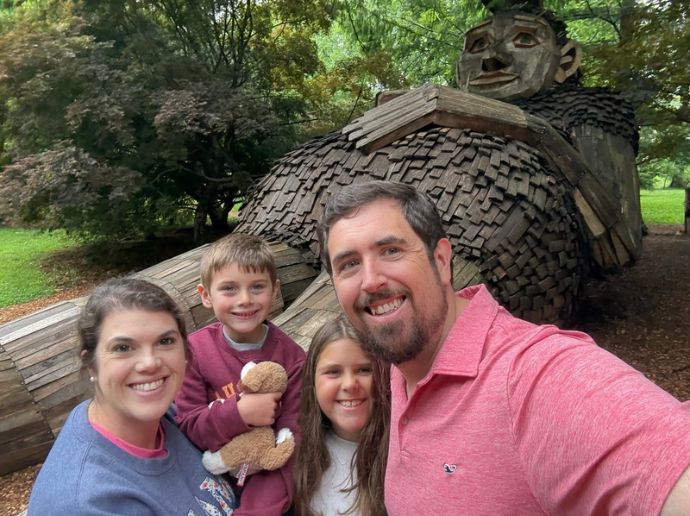
at Bernheim Arboretum in Kentucky on a road trip in Summer 2025.
Artificial intelligence is simply the latest chapter in the history of technology for Dr. Herron. Even a pen, he points out, was new technology once. What matters is how people choose to use the tool. He sees productive engagement with generative AI as an active process.
“I argue that a good relationship with generative AI is when you are writing more than you typically would have, because you're engaging with it in a serious conversation,” he says.
That conversation might involve challenging an AI response, explaining why it is wrong, revising an idea, or asking a better question. The work is in developing the judgment to determine what to do with that answer.
That is part of what he explored through a UAGC-funded OSSIF teaching and learning project, in which doctoral students volunteered for an AI literacy course focused on using AI as doctoral learners.
The students, he says, were “all over the place” as they figured out which tools to use, what constitutes appropriate use, and what kind of relationship they want with AI.
“It’s actually hard work to figure out what your relationship is with generative AI,” he says. “And that is part of the learning.”
Dr. Herron has also seen how AI can create opportunities for people who might not otherwise see themselves as technologically capable. He describes using Claude to build an app despite never having taken technology or computer science courses. Through an ongoing dialogue with the tool, he was able to experiment, ask questions, and bring an idea to life.
He sees similar possibilities for students, including English-as-a-second-language learners and neurodivergent students.
“One of the scariest things is the blank page, right?” he says. “Generative AI can get us a little bit past that. It can help us get past the intimidation of just getting started.”
Dr. Herron also believes that AI can help a person think, but it should not replace the person doing the thinking. His concern is less about whether people will use AI and more about whether they will stop contributing themselves. The distinction is important because, in his view, the most meaningful possibilities come from the combination of human and machine, not one replacing the other. That means educators may need to raise expectations rather than lower them.
“If AI can do C-level work, let’s ask our students to go beyond that,” he says.
And as students worry about what AI might mean for their future careers, he believes educators have a responsibility to show them where their own contributions matter.
“We think about our values, and what we’re after, and what’s important to us, and we double down on that,” he says. “And the technology is a piece of the conversation but doesn’t direct the conversation.”
Making Education Transformative
As a first-generation college student, Dr. Herron once struggled to imagine some of the academic milestones he would eventually reach. Earning a master’s degree — and later a doctorate — felt far beyond what he could see for himself. Then college changed his perspective.
Early in his college career, he recognized that he wanted to go into higher education.
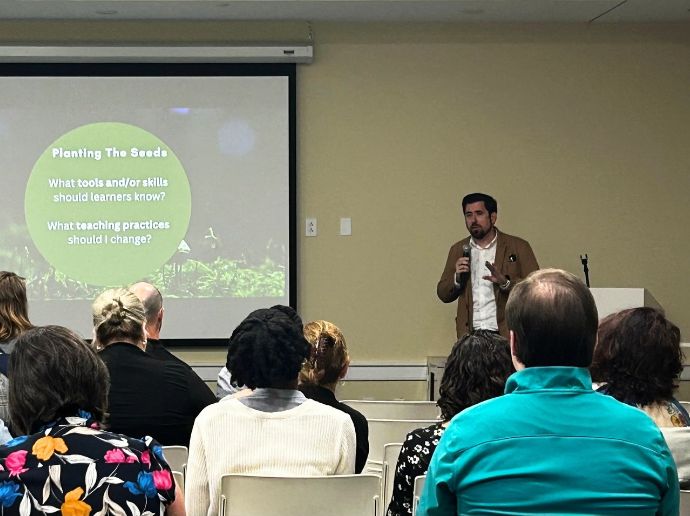
Learning Design and Technology event
in Summer 2025.
“I felt that it was such a transformative experience for me that I wanted to let others realize it can be transformative for them, too,” he says.
That idea has followed him throughout his career. He started as a teaching assistant before moving into instructional design and eventually administration. Along the way, a question in his mind kept evolving: “How can education become possible for more people?”
An early catalyst for his move into instructional design came when he was invited to join a task force reimagining communication and composition courses. As his institution explored a technology initiative, he began asking what it might look like to use technology intentionally to support learners. That also meant questioning long-standing practices that did not necessarily fit the learning experience he wanted to create. Blue-book exams, for example, did not align with his understanding of process pedagogy.
“What would it look like to embrace that process but also embrace technology?” he asks. “How about through a mobile and electronic portfolio?”
Throughout the semester, students worked on their essays and projects, continually revising, and the final assessment became an electronic portfolio. For Dr. Herron, moving from paper to electronic created a more authentic interface for students to see that they could continually change things.
“It’s not as final as a paper feels,” he explains.
Later, in administrative roles leading online programs and serving as a dean of online and continuous learning, his focus remained on expanding access. His work with the Online Learning Consortium, a global nonprofit focused on professional learning, offered another opportunity to help educators make learning possible for more people.
When he returned to teaching at UAGC, online education gave that mission a particularly personal dimension. His first-generation perspective remains present when he designs and teaches courses. This is especially relevant as he thinks about the student body at UAGC, many of whom have returned to school in their 40s, 50s, or 60s.
“They may not have seen higher education as something meant for them at one point or another,” he explains. “I think about what’s possible for my family members, and that’s what excites me about the work at UAGC.”
That perspective is especially evident in his work designing courses for the doctoral degree in organizational leadership and Master of Professional Studies in Leadership programs at UAGC, where he emphasizes the importance of planning well-designed courses that do more than deliver information. Instead, he suggested the programs help students recognize themselves in what they are learning and recognize how that learning connects to where they are going.
“I think a learning experience should be transformative,” he says. “That a digital learning experience can be transformative, too.”
Connection by Design
Transformation, however, does not happen in isolation. Dr. Herron shares how connection is one of the most important elements of learning, and it happens in more than one direction.
First, there is the connection students make with themselves and the material.
“Every student enters a course with existing skills, experiences, and frameworks,” he explains. “A meaningful learning experience recognizes those strengths while creating opportunities to develop new ones.”
Then there is student-to-student connection.
Students learn from one another, he says, whether they are undergraduates, doctoral learners, or faculty members participating in professional development.
“They bring different experiences, strategies, and tips and tricks to the learning environment,” he says.
Finally, there is the connection between students and faculty.
“The faculty member’s role is not simply to deliver information but to help students see how their learning connects to their own development and to the field they are entering or advancing within,” he explains. “That personalized connection can help students move from completing coursework to understanding why the work matters.”
It also reflects something Dr. Herron has come to understand throughout his career.
“Technology can and has changed the environment for learning, but it cannot define the purpose of learning,” he shares. “Only we can do that.”
Choosing Hope
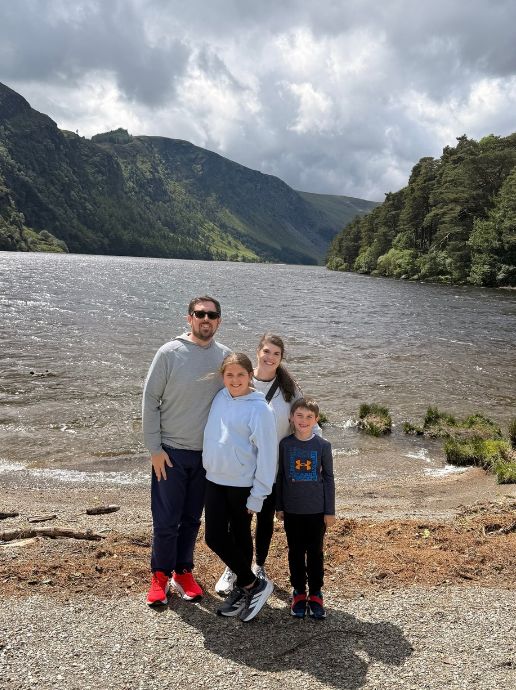
Glendalough, Ireland, in Summer 2026.
The value of intentional technology use comes through in an everyday moment Dr. Herron shared with his 10-year-old daughter. Her Apple Watch lets her head into the neighborhood with friends while giving her parents a way to stay connected. On weekday afternoons, about an hour after school, he calls to let her know it’s time to come home.
“We’re very intentional about unleashed technology,” Dr. Herron says. “The technology gives her more freedom that we otherwise wouldn’t be comfortable with, while strengthening the connection to home at the same time.”
That same balance applies to education. Technology will continue to change how people live and learn, but people can decide how — and how much — they let it shape their lives.
“The thing that I would hope people take away is that we can be hopeful,” he says. “That we have the ability and capacity to make change that's going to impact people positively.
“Even when it seems technology gets the headline, we are still driving that, and we should not give up on that.”
Getting to Know Dr. Herron
UAGC: What can students expect from your courses?
Dr. Herron: You can expect clear expectations and specific feedback. When I comment on your work, I'll point to what's working and show you exactly where to revise. Many of you are balancing school with full-time jobs, and the experience you bring from that work belongs in our discussions. If something in your life puts a deadline at risk, reach out early, and we'll work out a plan together.
UAGC: When you’re not working, what do you do for fun?
Dr. Herron: Most of my free time goes to my family. We love to travel and try to keep an adventurous spirit. Kids' sports and school activities are a big part of our calendar.
UAGC: What’s been your favorite destination and why?
Dr. Herron: Choosing one place is tough because I like to experience a variety of things when we take trips rather than putting too much weight on one specific city. For example, this summer, we did a cruise tour across the British Isles and other parts of Europe. While there are some spots on the itinerary that were some of my favorites (like Brugge and Edinburgh), the eight stops collectively made the trip memorable. Similarly, the summer before, we took an RV trip to experience several parts of Kentucky to get a broader perspective by visiting many stops. The journey is part of the fun for us.
UAGC: One thing on your bucket list?
Dr. Herron: I’d love to take a family trip across the United States and have time to enjoy all parts of it without feeling rushed and have something everyone enjoys as part of the itinerary. Mine would be knocking several National Parks off our list to visit.
UAGC: What is one book you’re reading right now or one you’d recommend?
Dr. Herron: I’m working on a visual design course for leaders right now, so I’ve been deep into some of the foundational texts there (like Edward R. Tufte) but also new ones like “Good Charts: The HBR Guide to Making Smarter, More Persuasive Data Visualizations” that makes those connections from history and foundations of visuals to where we are now and why it matters. I’m always reading different types of books, though, so my recommendation would be different next month. That’s the joy of my interdisciplinary work.
UAGC: What's something you've never had the chance to say about your academic journey?
Dr. Herron: My interdisciplinary PhD dissertation in 2017 looked at how people write and create with mobile phones, years before generative AI was part of mainstream vocabulary. The questions from that project turned out to be the same ones I study now, about how a new technology changes the way we write and think. I didn't see that connection coming when I picked my topic in grad school.
Are you thinking about growing your skills to prepare for the future of work? Explore UAGC programs and talk to an advisor about what you can make possible with a degree.