Key Takeaways
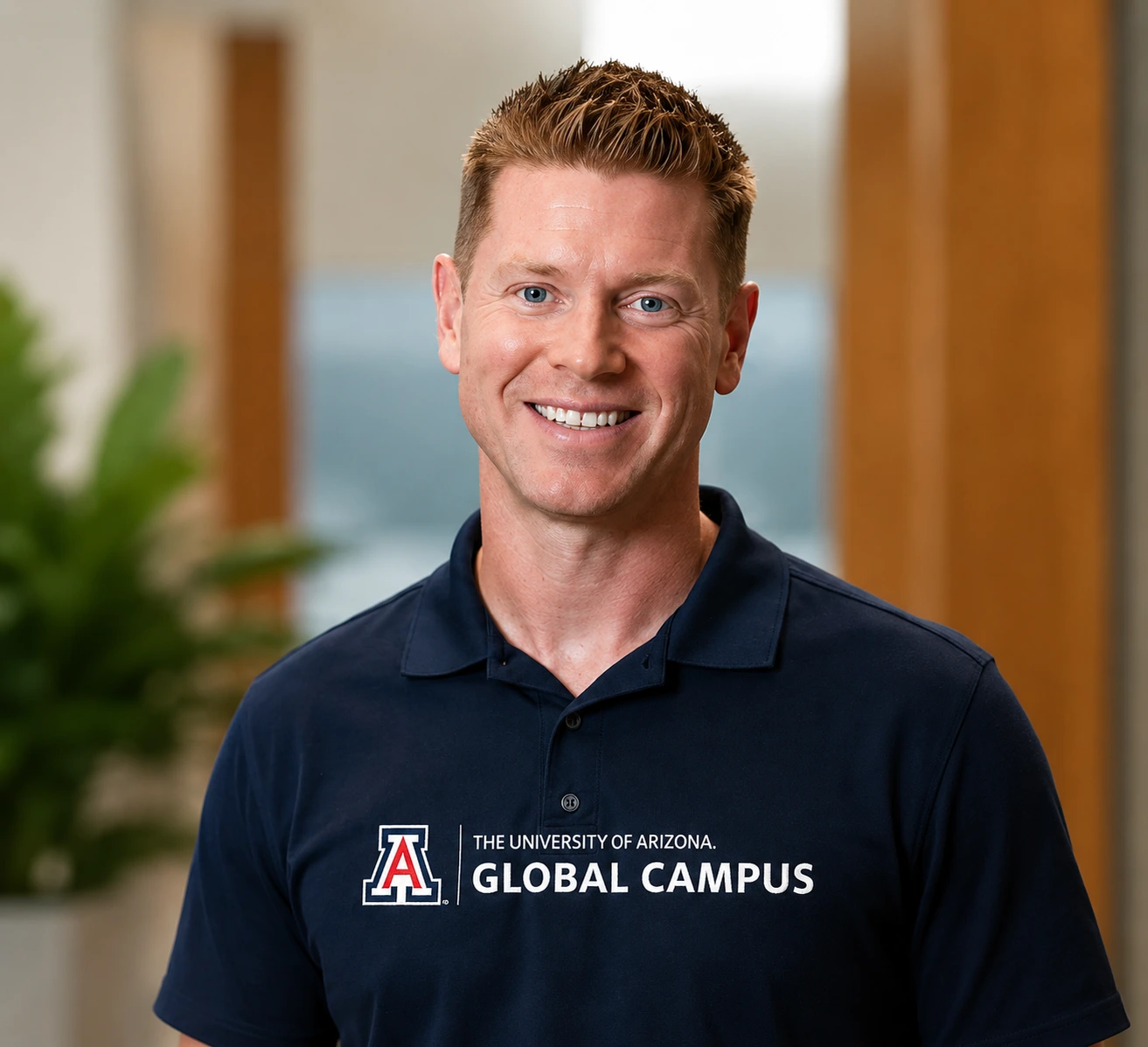
- UAGC faculty member Dr. Heidi Smith is a Department Head of Leadership Innovation Studies whose scholarship and presentations focus on curriculum innovation and evidence-based practices in higher education.
- Here, she shares about her life and experience across higher education institutions and what it means to her to be a leader.
- Leadership starts with connection, not hierarchy. Dr. Smith centers her leadership approach on accessibility, trust, and making space for honest human interaction.
- Intentional communication replaces passive collaboration in remote environments. Dr. Smith uses regular check-ins and informal conversations to combat isolation and build team cohesion.
- Cross-functional experience builds stronger institutional leaders. Her work across advising, graduate education, and student finance shaped her systems-level understanding of higher education.
- Real change in higher education requires cultural and structural shifts. Initiatives like the one-stop service center succeed only when people, not just processes, are aligned.
- Applied learning is reshaping graduate education through programs like the DPS. Dr. Smith says the Doctor of Professional Studies emphasizes real-world problem solving and tangible outcomes over purely theoretical research.
- Effective leadership balances clarity, empathy, and accountability. Transparency in decision-making and a people-first mindset help foster trust while still driving progress and innovation.
Meet UAGC Faculty Member Dr. Heidi Smith
The grid of faces flickers to life, then settles. Cameras are off, microphones muted. Where hallway chatter once filled the gaps between meetings, there’s now the hum of a laptop and the click of a cursor. For many remote workers, connection has been reduced to calendar blocks and agenda items.
It’s a reality Dr. Heidi Smith knows well and works against every day.
As Department Head of Leadership Innovation Studies, she begins meetings with a simple question: How are you doing today? A small but deliberate pause meant to restore what remote work can strip away.
“Being online is a challenge, but it’s one I’m up for,” Dr. Smith says. “If we want to stay a team, we have to stop waiting for connection to happen and start commanding it to exist."
“I want students to leave with something tangible, something they can take back to their workplace, something that shows how they solve problems and lead change.”
Connection, she’s learned, doesn’t happen by accident. It has to be designed. Even when it’s uncomfortable or resisted, she makes space for it.
“I don’t want somebody to feel like they’re not being heard or like they’re on an island,” she says. “There’s a real risk of that in an online environment.”
So, she brings her team together, sometimes with no agenda at all. Because people don’t leave their lives at the login screen.
“We all have stuff going on,” she says. “It’s important to recognize that.”
And in those first minutes of a meeting, something shifts. The grid becomes a group again — and, briefly, that hallway energy returns.
Building Perspective from the Ground Up
If Dr. Smith’s meetings are designed to close distance, her leadership philosophy follows the same logic: stay close, stay human.
She learned that early. As a program coordinator overseeing honors and study abroad programs at San Diego State University, she worked closely with highly engaged undergraduate students, an experience that shaped her advising style and grounded her in the day-to-day realities of student life.
“Those early years helped me set a standard for intentionality that I still carry with me,” she says.
She kept building from there. While working, she pursued a master’s degree in exercise physiology, driven by a lifelong connection to athletics. Then came a shift to student support in the chemistry department at SDSU. At UC San Diego, that view widened further as she stepped into student business services, learning the operational systems that underpin the student experience. Each move expanded her perspective, from undergraduate engagement to advanced research environments. Across roles, a pattern emerged.
“I wasn’t just moving between functions,” Dr. Smith explains. “I was connecting them. Student-facing, academic, operational. Each layer added to my understanding of how institutions and people work.”
This foundation set the stage for her first major project, where connection would become more than a philosophy. It would become the work itself.
From Silos to Systems
At UC San Diego, Dr. Smith stepped into her first major test: building a one-stop service center that would change how students navigated the university.
For years, student support offices operated separately, leaving students to piece together answers on their own. The goal was simple: bring it all into one place. The execution was not.
“That was my first real large-scale project,” she says. “And it’s where I learned that leadership is less about process and more about people.”
The challenge wasn’t designing the system. It was shifting mindsets.
“You’re asking people who’ve done things the same way for years to rethink everything,” she says. “Some were open. Some weren’t. So, I had to meet people where they were, build trust, and help them see the value.”
Success, she learned, depended on buy-in as much as strategy.
“If people don’t believe in it, it doesn’t matter how good the idea is,” she says. “You have to build that belief.”
The experience reframed how she saw higher education, not as isolated functions, but as an interconnected system.
“That’s when it clicked,” she explains. “It’s not just academics. It’s everything working together to support students.”
Just as influential was the leadership around her, mentors who balanced accountability with empathy.
“They gave me space to figure it out,” she says. “To vent, to problem-solve, to keep moving.”
It’s a model she carries forward.
“I want my team to feel like we’re in it together,” she says. “We can be collaborative, we can laugh when things don’t work and then figure out what’s next.”
That balance — serious work, human approach — became part of her leadership style. From there, she moved to Cal State Long Beach, helping launch one of the system’s first standalone doctoral programs. She carried that momentum to Trident University, where she supported the development of another doctoral program and went on to serve as Dean of Education for a decade.
“When you’re building something new, you’re not just solving for today,” Dr. Smith explains. “You’re shaping how it will grow, who it will serve, and what it stands for long-term.”
From early accreditation to enrolling the first cohort, she worked across faculty, curriculum, and policy to build something entirely new.
“The real work is in the connections, aligning people, priorities, and purpose,” she says. “When that clicks, everything else starts to move.”
Across each stage of her career, a clear pattern emerged: a leader who understands how institutions function by recognizing how people move through them — and how to support them at every step.
Designing Degrees for Real-World Impact
Dr. Smith’s holistic perspective of compounding her roles is the blueprint for her leadership; it’s why a simple check-in carries the same strategic weight as a department-wide program.
At the University of Arizona Global Campus (UAGC), it all converges in the launch of the Doctor of Professional Studies (DPS) in Organizational Leadership — a degree designed not just around what students learn, but what they’re able to do with the skills they learn.
“The DPS is a real opportunity to improve completion rates and strengthen students’ connection to the workforce,” Dr. Smith says. “But it requires a shift, from a PhD mindset to a true DPS orientation. And that’s not easy.”
The shift is both structural and cultural. It challenges traditional ideas of rigor and asks faculty to rethink what meaningful research looks like. For Dr. Smith, it’s familiar terrain: aligning people around a new vision, building trust, and creating momentum where there isn’t yet consensus.
“When you’re building something new, you’re not just solving for today. You’re shaping how it will grow, who it will serve, and what it stands for long-term.”
“It’s about getting faculty to think more creatively about what’s possible for these students,” she says.
At the center of the program is applied research, work designed to move beyond theory and into practice.
“I want students to leave with something tangible,” she says. “Something they can take back to their workplace, something that shows how they solve problems and lead change.”
That outcome is intentional. Not just a dissertation on a shelf, but a demonstration of impact, work that lives inside organizations and communities.
“This is about building people who can transform organizations, who can step in, assess a problem, and respond with real solutions,” she explains.
In a fast-moving, complex world, she argues, that ability is essential.
“You have to be able to think creatively and problem-solve almost immediately,” she says.
The DPS is structured to support that. Students tackle real problems of practice, guided by faculty, applying research methods that are both rigorous and relevant.
“They’re not just learning research, they’re using it,” she says. “Making sure the approach is solid and then carrying that skill set forward into their work.”
The program’s design reflects the layered nature of leadership itself. Specializations span individual performance, organizational effectiveness, community impact, and education.
“We’re looking at leadership from every angle,” she says. “Individual, organizational, community.”
For students, that creates more than options; it creates alignment.
“They can focus on the problems they care about and the kind of leader they want to become,” she says. “It’s a lot of work, but it’s good work.”
And like everything else in her career, it’s grounded in a broader view, one that sees education not as an endpoint, but as a tool for connection, impact, and change.
Leadership That Stays Human

Dr. Smith doesn’t describe leadership as authority or position. She describes it as proximity. For her, the job is simple in theory, harder in practice: stay close to people.
“I find myself bumping up against expectations,” she says. “Not because I don’t take the role seriously, but because I lead differently.”
That difference is intentional. She leads through collaboration, transparency, and trust, not hierarchy.
“My focus is making sure people feel like they’re part of the team,” she says. “I’m not top-down. That’s not how I work.”
Instead of filtering decisions through control, she focuses on clarity: making sure people understand not just what is happening, but why. Over the years, she’s learned that leadership styles that don’t fit a traditional mold often get questioned.
“At this point, people know I’m not going to lead in a way that isn’t true to who I am,” she says.
And like many women in leadership, she’s also had to navigate assumptions about how much support she has behind the scenes. Balancing leadership with solo parenting and personal responsibility is constant, she says — but not something she lets define her limits.
“I try to block out the noise,” she says.
Whether she’s launching a doctoral program, working with faculty, or opening a meeting, she returns to the same habit: asking people how they are before anything else. That philosophy extends to how she advises others stepping into leadership roles.
“You’re going to run into moments where your values get tested,” she says. “Stand your ground. Stay grounded in your ethics. Ask the questions you need to ask. Ask all of them.”
Early in her career, she didn’t always feel empowered to do that. Now she is intentional about giving that permission to others.
It’s a simple idea, but it shapes everything underneath it: curiosity, honesty, accountability — not just to work, but to people.
In a professional world that often rewards speed and distance, Dr. Smith leads the opposite way. She slows things down. She stays present. She stays reachable. And she keeps coming back to the same question, over and over again:
How are you doing today?
Because sometimes, she believes, leadership begins in the pause that follows.
Q&A: Get to Know Dr. Heidi Smith
UAGC: In your classes, what do you hope students take away beyond the coursework
Dr. Smith: "I want them to be less task-oriented and more curious. Ask questions, real questions. Not just about the assignment, but about the why behind it. There’s a human aspect to learning that can get lost if we’re just checking boxes."
UAGC: What does it look like when that curiosity starts to click for a student?
Dr. Smith: "You can feel it. Students start reaching out differently. Less formal, more themselves. I love that moment. I’m like, here we go, now I can see who you are. That’s when the real learning starts."
UAGC: How important is connection in an online environment?
Dr. Smith: "It’s critical, and it’s also the thing most at risk. There’s that distance factor where it feels like there isn’t a person in the room with you. I want students to feel like there is a person there, enough that they want to reach out and connect. It’s not just about engaging with the content, it’s about connecting with faculty, too."
UAGC: Outside of work, how do you stay grounded?
Dr. Smith: "I run or hike almost every day, usually about three miles. And I challenge people to try it without tech. No headphones, no distractions. Just engage with your environment, focus on your footsteps. It really is a kind of meditation."
UAGC: How would your friends and family describe you?
Dr. Smith: "Probably quick with a joke, active, and thoughtful. I like to show people I care in specific ways, like finding really unique gifts. I’ll do the research and try to connect with them in a way that makes them feel seen as an individual."
UAGC: If you could instantly master a new skill, what would it be?
Dr. Smith: "Speaking multiple languages. I studied Spanish in high school and ASL in undergrad, but I’d love to take that even further."
UAGC: What does leadership mean to you at its core?
Dr. Smith: "Leadership, for me, is not about distance. It’s about closing it. Everything I build comes back to that idea: staying connected, staying present, and making sure people feel seen."
UAGC: How does that influence how you think about innovation?
Dr. Smith: "Innovation is openness and creativity. But it’s also about making sure you’re hearing other voices. There’s a lot of amazing work we can do with more than ourselves in the room. I resist the pressure to move quickly just for speed. Sometimes you do have to have longer meetings just to sit together, think through what’s working, what isn’t, and throw ideas out."
UAGC: You’ve talked about learning being more than a moment. What do you mean by that?
Dr. Smith: "I think about cumulative learning, progress that builds over time, not isolated milestones. Education should be something lived, applied, and shared."