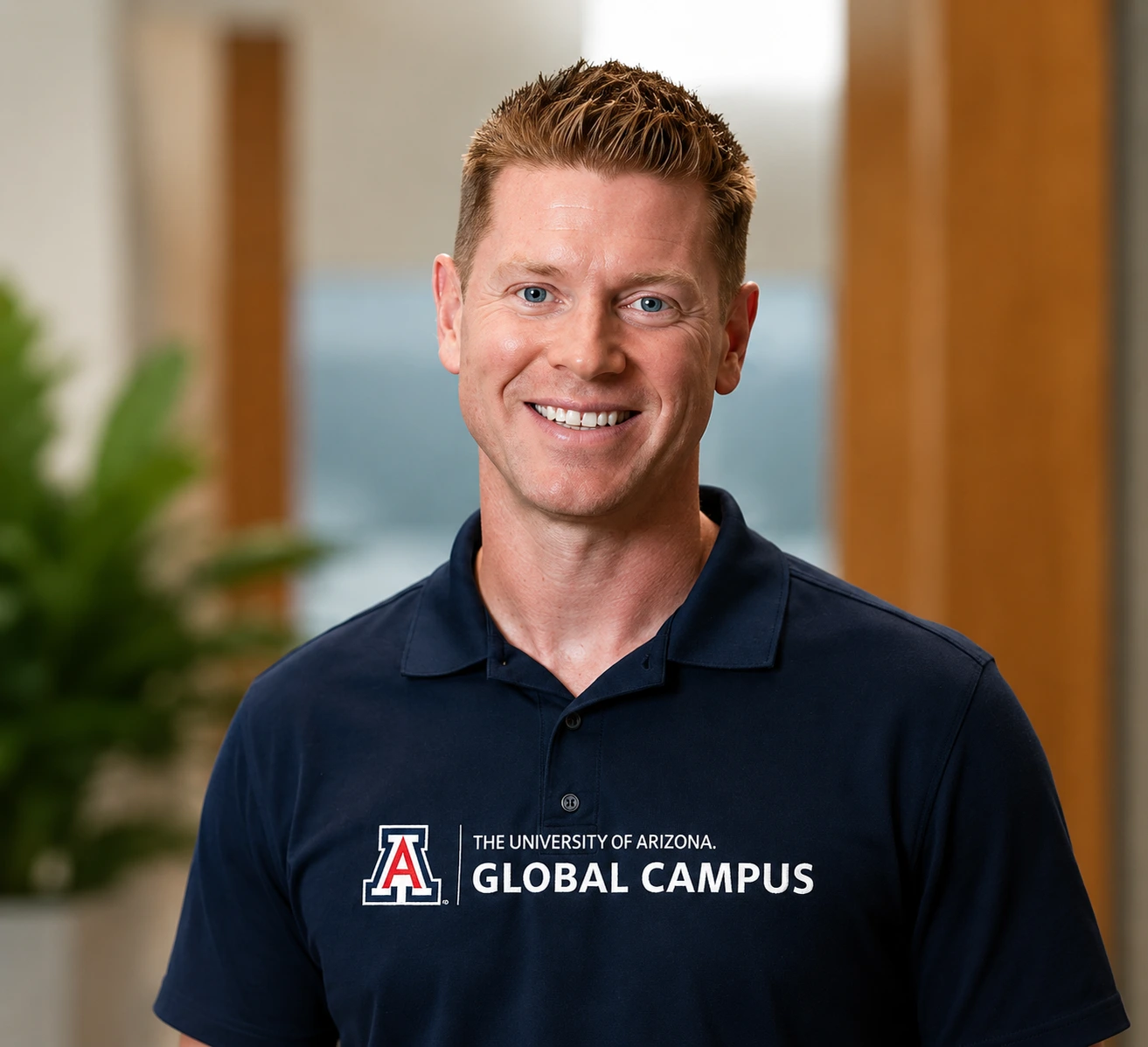
Key Takeaways:
- This student story explores the journey of Richard Amburgey, who earned his doctoral degree from the University of Arizona Global Campus (UAGC) in 2024.
- After 9/11, Richard left his career as a union journeyman to enlist in the Navy, beginning a path that would take him from military service into federal leadership.
- His Navy experience taught him the importance of preparation, staying calm under pressure, learning from failure, and documenting what works.
- Richard pursued doctoral study at UAGC because his professional experience had given him answers while also raising bigger questions about leadership, organizations, and the future.
- His doctoral work focused on succession planning and the loss of institutional knowledge, examining how organizations can become vulnerable when experienced employees leave without effectively transferring what they know.
- In his role as an instructor at the National War College, Richard continues the practice that began with a Navy mentor decades ago, recording lessons, failures, and insights as “Knowledge Nuggets” that can inform his own work and benefit the people who come after him.
The views attributed to Richard Amburgey in this article are his personal views and do not necessarily represent the views of the U.S. Department of Justice, the National Defense University, the National War College, the U.S. Department of Defense (also referred to as the Department of War), or the United States Government. Reference to his government position does not imply government endorsement.
--
Richard Amburgey Turns Experience Into Lessons for the Next Generation
The first time Richard Amburgey stood at the National War College as an instructor, he caught himself smiling.
Walking through Roosevelt Hall for his first convocation in his new role as Department of Justice Chair and Instructor, Department of Security Studies, he was struck by the significance of the moment.
He compares the feeling to a lifelong baseball dream finally coming true: growing up hoping to play professionally, working toward it for decades, and then getting the call that you have been drafted by the New York Yankees before walking onto Yankee Stadium field for Opening Day.
“This wasn’t luck,” he says. “It was the result of a lifetime of service, a willingness to keep learning, and the investment others made in me along the way.”
That lifetime of learning includes Richard’s military service, federal career, and doctoral education at UAGC. He has spent over 30 years in federal and military leadership. Along the way, he developed a practice of capturing what he learned — lessons from successes and failures, frameworks, observations and questions — and preserving them for future use. He calls them “Knowledge Nuggets.”
The idea has become more than a note-taking habit. It is an ideology that has shaped how Richard approaches his career, his scholarship, and now his work preparing future national security leaders. His story will show that the future, although unwritten, can be prepared for, a little every day.
“I hope you feel possibility, but not the cheap version of possibility where everything works out because you believed hard enough,” he says. “I want you to see that a blue-collar tradesman can become a sailor, a federal leader, a scholar, and a professor, not because there was a master plan, but because each chapter was treated as preparation for whatever came next. Your starting point matters. It just does not get the final vote.”
From Service to Scholarship
Richard’s journey into higher education began shortly after September 11, 2001. Until then, he had been working as a union journeyman in heating and air conditioning. The attacks changed the direction of his career.
“I left work that day knowing I wanted to do something,” he says. “At that age, my thinking was pretty simple: I wanted to serve, I wanted to help, and I wanted to make damn sure nobody ever did something like that to us again.”
He enlisted in the Navy, beginning a career in service that would eventually lead him into federal government and national security work. The military gave him more than professional experience. It taught him how to prepare, adapt, and learn from what happens when plans meet reality.
“I learned that I am at my best when the stakes are real, the mission matters, and people are counting on me,” he says. “I also learned that calm is not something you either have or do not have. You build it through preparation.”
His work in dignitary protection reinforced that lesson. The public may see only the few minutes when everything goes according to plan. The professionals, he explains, are thinking about the hundred things that could go wrong before the principal ever walks through the door.
“Calm under pressure is usually preparation wearing civilian clothes,” he says.
That mindset followed him into education. While serving in the Navy, Richard earned his bachelor’s degree in criminal justice. After his service, he earned his master’s in criminology. Years later, when he began his doctoral study, he recognized that many of the habits he had developed through military service translated naturally to scholarship.
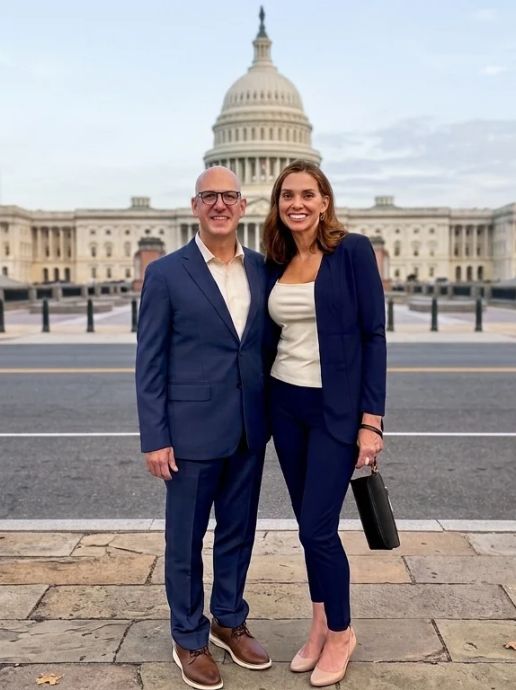
a fitting backdrop for a journey shaped by education,
public service, and unwavering family support.
“Discipline certainly helped, but I think curiosity helped more,” he says. “The Navy taught me to study the mission, anticipate failure points, learn from people who knew more than I did, and conduct an after-action review when things did not go as planned.”
While a doctorate uses different terminology, the underlying process felt familiar: ask a difficult question, gather evidence, challenge assumptions, document what you find, and remain willing to discover that your original answer was wrong.
“Research and operational planning share a useful discipline: assumptions are not evidence,” he shares.
Finally, one of the most enduring lessons came from a Navy mentor who encouraged him to keep a workplace journal, and another for himself. Richard still carries that practice today. If he doesn't have a notebook, he records his thoughts digitally. Those observations became his own growing collection of Knowledge Nuggets.
Asking Better Questions
By the time Richard seriously considered doctoral study, he was already well into his career. He had completed executive education through Harvard Kennedy School of Government and Northwestern Kellogg School of Management, participated in leadership development programs, and built years of experience in federal service. He wasn't returning to school because he needed another credential.
“On paper, there was no obvious reason I needed another degree,” he notes.
Richard was returning because his experience had started giving him answers and, at the same time, raising more questions. And the weight of those questions kept growing.
“I wanted to understand why some organizations learn, adapt, and prepare their next generation while others keep rediscovering the same problems,” he says. “I was not trying to reinvent myself. I was trying to understand the career I had already lived well enough to prepare for the one still ahead of me.”
Research and operational planning share a useful discipline: assumptions are not evidence.
Another lesson from his Navy mentor continued to guide him: Know your job inside and out. Then learn everything that can go wrong and know what you will do when it does.
“The higher I moved, the more I realized the problems were becoming less technical and more human, organizational, and strategic,” Richard says. “I knew how to fix a lot of things. I wanted to understand the systems that kept producing the things that needed fixing.”
That search led him to the doctoral program at UAGC.
“The program immediately made sense to me because it sat at the intersection of everything I had been doing professionally and everything I wanted to understand better,” he says.
“Eventually I realized I was no longer satisfied just fixing the immediate problem. I wanted to study the pattern. Around 2020, I decided that if I was serious about the second half of my career, I needed to stop saying ‘someday’ and start preparing for it.”
When the Knowledge Became a Forecast
Doctoral education became an opportunity to challenge longstanding assumptions and look at familiar problems from different angles. That approach became especially important in Richard’s Applied Doctoral Project, which examined succession planning and institutional knowledge within national security positions, research he still refers to today.

enjoying family time along the shores of Lake Michigan in Indiana, summer of 2024.
His concern was straightforward: What happens when experienced people leave an organization without effectively transferring what they know?
An empty position is a lot more than a loss. It can mean losing years of context, expertise, and lessons learned, creating vulnerabilities that can weaken an organization and, ultimately, national security, he explains.
“I used to put more weight on the individual leader,” he explains. “I still believe leadership matters enormously, but I now think strong institutions cannot depend on finding a hero every time something goes wrong. If the organization only works because one exceptional person is holding it together, that is not resilience. That is a warning sign. Leadership includes building systems, developing successors, and transferring judgment so the institution can perform after you leave.”
He saw multiple waves of departures compound the problem: employees who accepted voluntary buyouts or early retirement, those who were furloughed or dismissed, those who left voluntarily, and those who, amid uncertainty, became disengaged.
His dissertation had become a lens through which he could interpret events unfolding around him. It was the foundation for seeing the world differently.
“My goal is to move the research beyond the dissertation into articles, policy work, teaching, and eventually practical approaches agencies can use to protect institutional knowledge and leadership continuity,” he says. “A strategy is only as executable as the institution responsible for carrying it out.”
Capturing What Comes Next
Today, Richard is putting those lessons into practice as Department of Justice Chair and Instructor at the National War College, where he teaches National Security Strategy Studies as part of a one-year rotation, with the possibility of additional years.
The assignment may be temporary. The knowledge he hopes to leave behind is not.
That brings him back to the idea of Knowledge Nuggets.
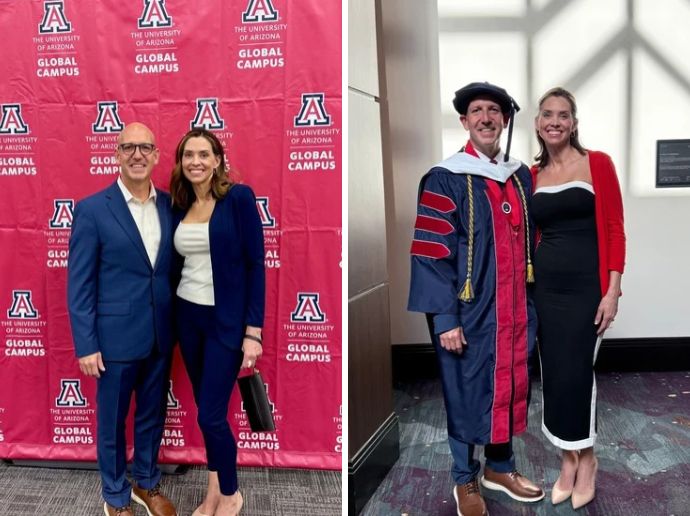
a milestone years in the making and an achievement shared by both.
“Right at my last year at UAGC, I finally figured out that this is what I need to be doing,” he says. “My responsibility is to grab knowledge, capture it, retain it.”
That means turning experience into something that can outlast the person who experienced it.
“In addition to giving it back to the person behind me, I want to find a way to put it in a time capsule so it's there forever,” he says.
The military has its own terminology for this work: hot washes, after-action reports and lessons-learned documents.
These hot washes or “knowledge nuggets” can be big or small. A major lesson from a career-defining experience. A mistake worth remembering. A framework that changes the way you think. Or even a single sentence at the end of a day capturing what worked, what didn't, what was difficult, or what you learned about yourself. He encourages others to start there.
“If you're not journaling — and I'm not talking about writing a diary — it could just be a one-sentence summary of capping off the day,” he says. “After a year, hell, after one month, just having that as a catalog and looking back on it is motivating. It really is. But it's also eye-opening, and it helps you develop as a person.”
The future, he says, rarely tells us exactly what it will require.
“Your job is to be ready when it does arrive,” he says. “Just always be open and willing to take what opportunities present themselves to you. Be open to knowledge, learning, never stop.”
Ready to capture your own experiences, challenge what you think you know, and prepare for what comes next? Explore UAGC degree programs or connect with an advisor to learn more.
--
The views attributed to Richard Amburgey in this article are his personal views and do not necessarily represent the views of the U.S. Department of Justice, the National Defense University, the National War College, the U.S. Department of Defense (also referred to as the Department of War), or the United States Government. Reference to his government position does not imply government endorsement.