Key Takeaways
- This student story highlights John Harris, who is currently pursuing his Bachelor of Arts in Applied Behavioral Science at the University of Arizona Global Campus (UAGC).
- An Air Force veteran and current UAGC student, John sees his name on the National Military Monument alongside family members and members of the UAGC Student Veterans Association.
- After noticing similarities between himself and some of his behavioral health clients, John pursued an ADHD diagnosis that helped him better understand his learning style and develop more structure in his education.
- His path through higher education has included multiple schools and program changes, military service, and a career in behavioral health before he found his niche in Applied Behavioral Science at UAGC.
- As a Lead Behavioral Consultant, John works with clients, many of whom are on the autism spectrum, helping them develop communication skills and find ways to express themselves.
- Through the UAGC Student Veterans Association chapter, he has found a supportive community and now mentors other student veterans, drawing on his own experience returning to school.
- Looking toward graduation and future leadership, John hopes to advocate for people who are overlooked or ignored, embracing his role as a voice for others while encouraging students to “find your path, and stick to it.”
--
Air Force Veteran and UAGC Student John Harris Finds His Voice Through Behavioral Science
Seeing your name on a national monument is the kind of moment that doesn’t come around often.
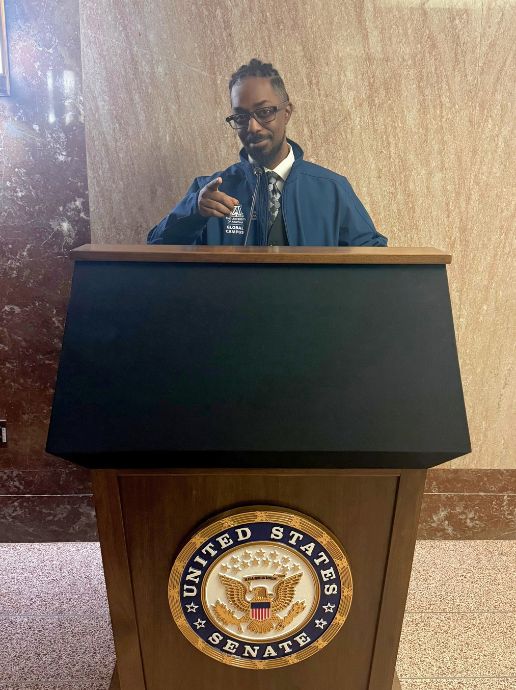
For John Harris, an Air Force veteran and current UAGC student, the experience was made even more meaningful by the names surrounding his own: his grandfather, his great-uncle, fellow Air Force members, and members of the UAGC Student Veterans Association.
“It reminded me that military service is never just one person's story,” John writes in a UAGC Connect post about his trip. “It is generations of families answering the call. It is the friendships forged through service, the bonds that never fade, and the veteran community that continues to support one another long after the uniform comes off.”
The National Military Monument, located near the Lincoln Memorial in Washington, D.C., honors more than 41 million Americans who have served. When John saw his name among them, it was almost difficult to process. He sat for 10 or 15 minutes simply letting the moment sink in.
“My name may be on that monument, but this moment was never just about me,” he shares. “It represents all of us who answered the call to serve.”
That sentiment could just as easily describe the path that brought him there.
Today, John is a Dean’s List honoree pursuing a bachelor’s degree in Applied Behavioral Science at UAGC. He mentors fellow student veterans and remains deeply involved in the UAGC community, all while working as a Lead Behavioral Consultant.
“Behavioral health is more than simply a job for me; it was my calling,” he says. “As I gained experience working with individuals and families, I wanted to better understand human behavior and strengthen my ability to make a meaningful difference. I enrolled at UAGC to pursue my degree in Applied Behavioral Science and build the educational foundation necessary to continue advancing professionally while becoming a stronger advocate and resource for the people I serve.”
Along his journey toward an education at UAGC, John has changed schools, changed programs, and learned more about how his own mind works. Through it all, he’s come to understand not only what he wants to do, but who he wants to stand up for.
“There are a lot of individuals that are overlooked and ignored,” he says. “So, if that's the case, I'm gonna be their voice.”
Understanding Himself by Understanding Others
 For the past four years, John has worked as a behavioral consultant with Alternative Paths Training School, a job where no two days look quite the same.
One day, he might walk a client around the mall while practicing social engagement. Another might involve helping a client identify and communicate her emotions before ending the session with a game of UNO or letting her paint his nails. The variety suits him.
Many of his clients are on the autism spectrum, and John is passionate about helping them find their voice or discovering another way to express themselves. Eventually, he began noticing some parallels between himself and some of the people he worked with.
“I decided to get tested because I started to notice a lot of similarities between myself and a lot of my clients,” he says. “For me, it was just kind of finding out, like, hey, do I have ADHD or anything like that?”
The diagnosis helped John make sense of things he had experienced throughout his life, including physical stims, the way he thinks, and some of the challenges he had encountered in school. Rather than limiting him, the information gave him a new way to understand himself.
“Having that information was, at least for me, kind of empowering, because it helped me better develop structure and understand my needs,” he says.
Structure has since become an important part of how John approaches work and school. While he knows he can perform well under a deadline, he has learned that leaving everything until the last minute is not necessarily the best strategy for him. So, he builds routines into his week. Sundays are typically reserved for peer responses, giving him time to read, gather his thoughts, and submit his work without rushing.
“I have had to become more intentional about managing my time, creating structure, staying organized, and holding myself accountable,” John explains. “While it has not always been easy, navigating these challenges has strengthened my discipline, perseverance, and ability to adapt, while proving to myself that ADHD does not define what I am capable of accomplishing.”
Finding His Path
John’s relationship with education has included its share of starts and stops. After high school, he followed his father’s footsteps and attended Delaware State University as an accounting major before switching to general business management. By his fourth year, he was approaching burnout and decided to take a semester away from school and enlist in the military.
 “I've always kind of had the idea of going to the military because my grandfather was in the military,” he shares.
Joining the Air Force as a Munitions Systems Technician became an important milestone for another reason, too. It was one of the first major decisions John made entirely for himself.
“My parents didn't even know about it until I'd already signed my contract,” he admits.
And while they were supportive of his decision, this was a pivotal moment for John. He was forging a path of his own design. And he still uses his military training today.
“It taught me organization skills and the best ways for me to learn information,” he explains.
At UAGC, those skills have helped him earn Dean’s List honors, something he had never accomplished before.
Today, UAGC is the fourth school John has attended, and Applied Behavioral Science is his fourth field of study. However, this time feels different.
“After my military service and several different career paths, I eventually discovered my true passion in behavioral health,” he says. “Ever since I got into the behavioral health field, I knew I found my niche. And I really just want to continue moving forward with it.”
An Education He Can Use
As John settled into behavioral health, he also began thinking about what might come next. His current role offers more flexibility, and he wants to move up the ladder. A bachelor’s degree seemed like a natural next step, so with encouragement from his colleagues, he began looking at schools.
Initially, he searched for psychology programs because he assumed psychology would be the closest academic match for his work. Then he spoke with a UAGC enrollment advisor.
 Instead of simply giving him the program he had asked for, the advisor listened to what John actually did. She introduced him to Applied Behavioral Science, provided course breakdowns for both programs, and gave him the information to decide which path made the most sense. That interaction, John shares, is ultimately what helped him make his decision to enroll.
“Coming back to school, you sometimes might feel alone in your journey,” John says. “So just having someone to remind you, ‘hey, you've got me, and since you've got me, you've got a whole bunch of other people to support you,’ means a lot. With UAGC, it was, ‘I'm gonna check in on you, and I'm actually gonna treat you like an individual and not just a number.’”
Now, John brings that individualized approach into the classroom, where he frequently connects his coursework to his professional experiences.
A class on Communication and Conflict, for example, gave him tools he could apply directly to his work with clients who use nontraditional forms of communication. Leadership and Ethics reinforced the importance of ethical decision-making in behavioral health. Psychology of Criminal Behavior strengthened his research and behavioral-analysis skills.
His current course, Cultural Awareness and Human Services, has prompted him to think even more deeply about the individual experiences his clients bring with them.
“Pursuing my degree has already had a significant impact on my career and personal growth,” John shares. “What I have learned through UAGC directly complements my work in behavioral health and has strengthened my understanding of human behavior, intervention strategies, communication, and leadership. It has also given me greater confidence in my professional abilities and helped prepare me for continued advancement in the behavioral health field.”
Even when people share similar backgrounds, John knows their experiences can be entirely different.
“No matter what class I'm taking, I'm always able to find at least one gem I can take from it to build upon,” he says.
A Community Worth Showing Up For
Whatever free time remains in his schedule, John often gives it to the UAGC Student Veterans Association (SVA) chapter: attending meetings, helping organize events, and mentoring other students. He jokes that his friends tell him he is always busy. But he has grown comfortable with that rhythm.
“I think that's one reason why I've been doing so well with the schooling,” he says. “I don't have that time to get lazy or get complacent.”
The SVA has also given him something beyond another responsibility: a community.
He initially joined because he was a student veteran. At his first meeting, however, he found an environment that felt less formal than he expected, full of conversation, jokes, and genuine interaction. His first mentor, Daniel White, who was SVA chapter president at the time, remains a friend today.
“SVA has been amazing,” he exclaims. “It's like having members of the family, you know, they're supporting me as well.”
That experience showed John the value of having someone who understands the particular challenges of returning to school, especially for students whose educational journeys may look very different from one another.
“Having that resource of someone who understands what you're going through, has already experienced some of the classes, some of the structure — and being that additional support is important,” he says.
Paying It Forward
When John looks toward life after graduation, he sees more milestones ahead, professional certifications, a master’s degree, and eventually leadership opportunities within the behavioral health field. But his ambitions are not only about moving up. He also wants to expand what he can do for the people he serves.
The organization where he works has grown into a broader community outreach operation, and John hopes to help expand its reach while developing his own career in behavioral health leadership. At the center of those plans is advocacy.
“Looking back,” he reflects, “my journey may not have followed a straight path, but every chapter has helped shape the person I am today and taught me something about service, perseverance, leadership, and the importance of helping others.”
He has heard stories from current clients that still bother him. Sometimes, he wonders whether earlier intervention could have changed what happened to them. And while he cannot change the past, he can use what he has learned to try to make the future different for someone else.
That philosophy is also reflected in the way John talks about recognition. When he stood before his name on the National Military Monument, he was thinking about the people whose names surrounded his own, and the importance of recognizing their contributions while they are still here to receive it.
“Giving them their flowers while they can still smell them,” he says.
So, through his own journey, John is honoring the people who came before him. He is learning from the experiences that shaped him. He is finding ways to support the people walking beside him. And he is preparing to use his education to advocate for those who may not always have a voice.
His advice to other students is straightforward: “Find your path, and stick to it.”
To find your own path forward, explore UAGC degree programs and discover how your experiences can help shape what comes next.
--
The Bachelor of Arts in Applied Behavioral Science is not designed to meet the state educational requirements for a specific professional license or certification in any state. Students seeking licensure or certification in a particular profession shall carefully research the requirements prior to enrollment and regularly review the requirements as they are subject to change. Requirements vary by state. The University of Arizona Global Campus does not guarantee that any professional organization will accept a graduate’s application to sit for any exam for the purpose of professional certification. Further, a criminal record may prevent an applicant from obtaining licensure, certification, or employment in their field of study.
Student success stories should not be interpreted as a promise or guarantee of career advancement or future earnings. The stories shared here represent the outcomes of individual students for illustrative purposes only.