Key Takeaways
- Professional Studies degrees are built for the modern workforce. Unlike traditional degrees centered on theory and broad exploration, Professional Studies degrees are designed around career-relevant outcomes, industry-aligned competencies, and real-world application—preparing graduates to demonstrate what they can do, not just what they know.
- Interdisciplinary thinking is a competitive advantage. The World Economic Forum's Future of Jobs Report 2023 identifies analytical thinking, creative thinking, and adaptability as the most in-demand skills—none of which are discipline-specific. A Professional Studies degree is purpose-built to develop exactly these cross-domain capabilities.
- Employers are demanding more from higher education. A 2024 Hult International Business School survey found that 96% of HR leaders believe colleges need to take more responsibility for workforce training. Professional Studies programs are designed to close that gap.
- Applied degrees have a long, respected academic tradition. The MD, JD, EdD., and DBA are all professional degrees—rigorous, practice-oriented credentials no one questions. Professional Studies sits within that same tradition, extending it to working adults at multiple degree levels.
- It's the right degree for the right person. Professional Studies is especially well-suited for working adults, career changers, and lifelong learners who need a flexible, structured path that doesn't require stepping away from their lives—without sacrificing academic rigor or credential value.
What Is a Professional Studies Degree?
Choosing a college major is one of the first big decisions many students make — and for some, traditional academic paths don’t quite fit their goals. That’s where a professional studies degree comes in. Because a professional studies degree is suited for the modern world. Designed to bridge the gap between theory and practice, a professional studies degree focuses on real-world skills, applied learning, and career readiness. Whether you’re a recent high school graduate, a working adult returning to school, or someone looking to pivot careers, understanding what a professional studies degree is and how it differs from more traditional programs can help you decide if it’s the right path for you.
This guide to professional studies degrees will cover what the degree means, how it differs from other undergraduate and graduate programs, and the careers it can prepare you for. We’ll also explore who benefits most from this flexible, career-focused path and what to consider before enrolling.
What Does Professional Studies Mean?
According to the National Center for Education Statistics’ Classification of Instructional Programs (CIP), professional studies programs are instructional programs classified within applied and interdisciplinary fields of study that are designed to prepare individuals for professional roles through integrated academic and career-focused coursework. A professional studies degree is a workforce-aligned academic credential built for working adults who want to move forward in their careers without stepping away from them.
At the University of Arizona Global Campus (UAGC), these programs center on applied learning, industry-relevant competencies, and real-world projects that demonstrate practical capability, not just academic knowledge. Where traditional degree titles often signal broad exploration or research preparation, professional studies is intentionally purpose-driven: helping learners move into the next stage of their careers faster and with greater clarity.
Further, career site Zippia provides the following definition of professional studies degrees: “A professional studies degree is an academic program that is interdisciplinary or applied in focus. A professional studies degree can be either an undergraduate or graduate degree, depending on the profession the degree is related to. A professional studies degree can be classified as any of the following degrees: bachelor's, master's, doctoral degrees.”
Is Professional Studies a Major?
Professional studies is best understood as a degree type or classification, not a major. It can exist at the bachelor's, master's, or doctoral level, and is defined by its interdisciplinary, applied focus rather than by a single subject area. The "major," or area of focus, lives within the degree — professional studies is essentially the framework that holds it together.
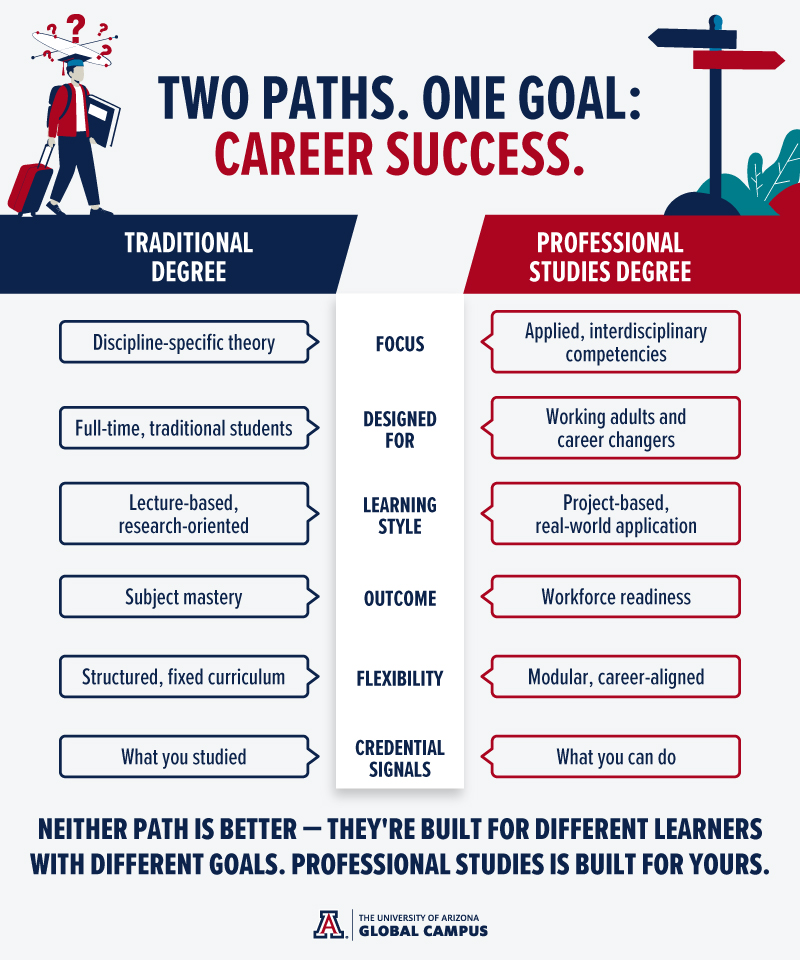
The credential signals how you learned (applied, workforce-aligned, competency-based) as much as what you studied. Professional studies signals practical readiness and career mobility, which focuses on catering to modern people in the modern working world.
Is a Professional Studies Degree Good?
If you’re wondering if a professional studies degree is good, the short answer is “yes,” but also, it depends on you. For many working adults, it may be the better choice. Let’s break down some of the differences between a professional studies degree and traditional college degrees below.
- A Professional Studies Degree is Built for the Real World
A professional studies degree is designed from the ground up around applied learning and career-relevant outcomes. Rather than focusing on theory for its own sake, it builds competencies that translate directly into workplace performance. While traditional learning and college degrees are built around theory, philosophy, and general education (all helpful foundations to have), professional studies degrees equip you with the in-demand skills employers require right now. Employers increasingly value what candidates can do, and Professional Studies graduates are trained to demonstrate exactly that.
- The Flexibility of a Professional Studies Degree Is a Strength
The interdisciplinary nature of professional studies isn't a weakness — it's a feature. Today's workplace rarely fits neatly into a single discipline. Professionals who can think across domains, adapt quickly, and apply knowledge in complex, real-world environments are in high demand. And increasingly, the data backs that up.
The problems professionals are asked to solve — from navigating organizational change to leveraging emerging technology to leading diverse teams —draw from multiple domains simultaneously. According to the World Economic Forum (WEF), education in the 21st century must go beyond imparting knowledge; it must cultivate the skills and mindsets needed to solve complex, interdisciplinary problems. WEF President Raquel Bernal writes, “The future of education demands systems that are flexible, adaptable, and personalized. Traditional one-size-fits-all approaches no longer suffice in a world where individual aspirations and career trajectories are increasingly diverse. Innovations such as stackable credentials, which allow learners to build qualifications incrementally, and modular programmes tailored to specific skills are gaining traction globally.”
A degree built around a single field, no matter how deep, can leave professionals underprepared for the full complexity of modern work.
- A Professional Studies Degree Meets the Demand for Skills
Employers are signaling this shift loudly as well. The WEF's Future of Jobs Report 2023 — drawing on data from over 800 companies employing more than 11 million workers — found that analytical thinking and creative thinking are the most in-demand core skills, followed closely by resilience, flexibility, and agility. These are not discipline-specific competencies. They are cross-domain capabilities, exactly the kind cultivated through interdisciplinary, applied learning.
As technology continues to reshape industries and new jobs emerge requiring "hybrid" skills, expertise in a single domain will no longer suffice. Working professionals increasingly need to synthesize knowledge across fields while committing to real-world, scenario-based learning that is flexible and interdisciplinary.
- A Professional Studies Degree Prepares for Real-World Readiness
The demand for cross-functional thinkers is also reshaping how organizations develop their own talent. LinkedIn's 2024 Workplace Learning Report found that companies encouraging employees to stretch into different internal roles reap higher retention rates, a more agile pool of workforce skills, and employees with deeper cross-functional knowledge. In other words, the professionals who thrive are those who can move fluidly across roles, teams, and challenges — not those tethered to a single specialty.
A 2024 survey by Hult International Business School found that 96% of HR leaders believe colleges need to take more responsibility for workforce training, a clear signal that the gap between traditional academic preparation and real-world readiness is widening. Professional studies programs are designed to close that gap, equipping learners not just with knowledge, but with the adaptive, integrative thinking that employers are demanding now.
In a workforce where the rules keep changing, breadth isn't a liability. It's a competitive edge.
- A Professional Studies Degree Offers Accessible Without Sacrificing Rigor
For working adults balancing careers, families, and education, professional studies programs offer a structured, rigorous path that doesn't require stepping away from life to pursue a degree. The credential is earned through meaningful, applied work, not just seat time.
- A Professional Studies Degree is a Credential with Growing Recognition
As workforce-aligned education continues to gain traction with employers, professional studies degrees are earning increasing respect across industries. At institutions like UAGC, the degree reflects a deliberate, modern approach to higher education, one that prioritizes career mobility and real-world impact.
A professional studies degree is a smart, purposeful credential for motivated professionals who want to move forward in their careers with clarity and confidence.
How Does a Professional Studies Degree Compare to Traditional Degrees?
There's a common misconception that applied or professionally oriented degrees are somehow less rigorous or less legitimate than their traditional counterparts. The academic record tells a different story.
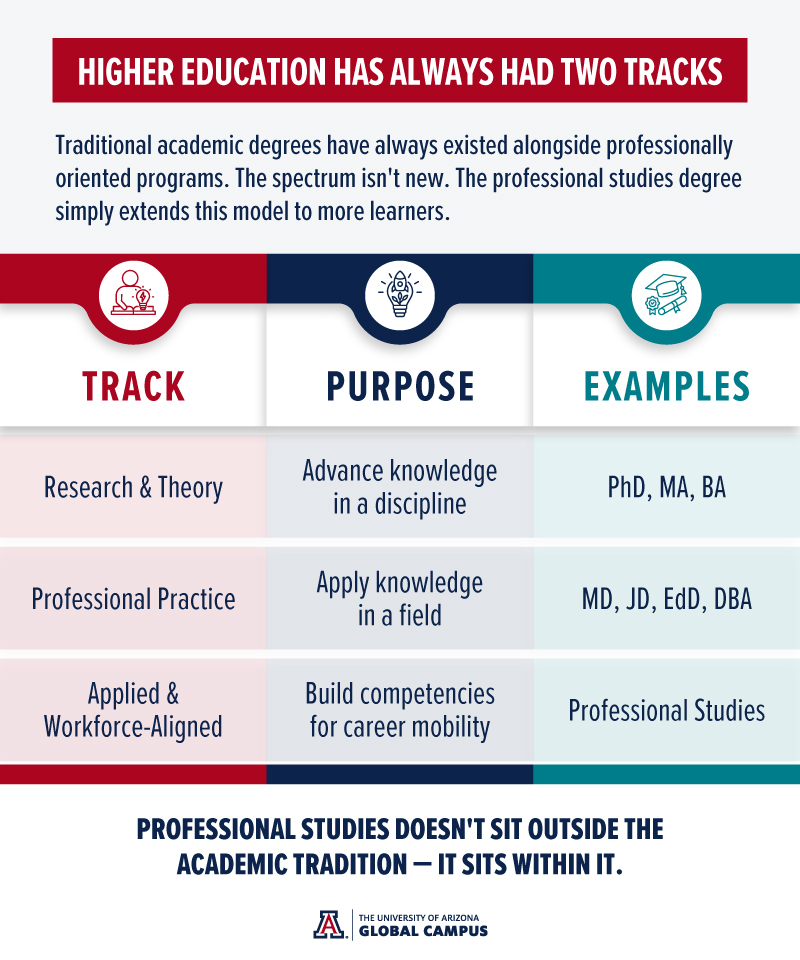
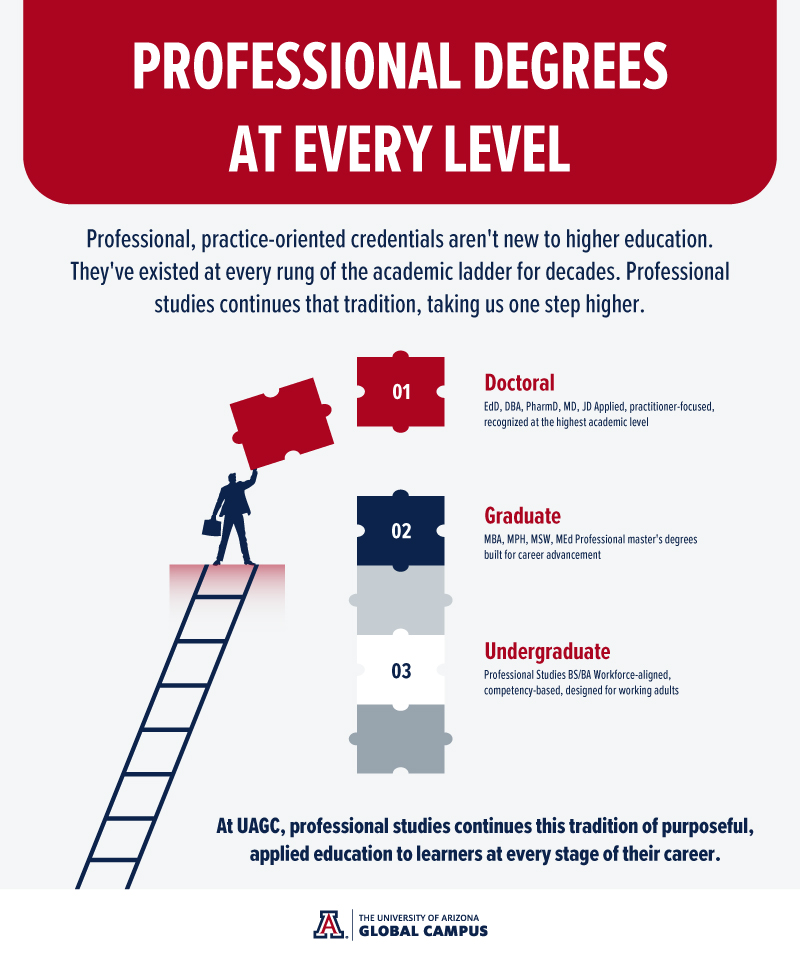
Some of the most respected and well-compensated credentials in higher education are, by definition, professional degrees. The Doctor of Medicine (MD) prepares physicians to practice medicine. The Juris Doctor (JD) prepares lawyers to argue cases. The Doctor of Pharmacy (PharmD) prepares pharmacists to dispense prescriptions. These are applied, practice-oriented credentials designed to produce competent, workforce-ready professionals. No one questions the merit.
The Doctor of Education (EdD) and Doctorate of Business Administration (DBA) follow the same logic at the doctoral level. While the Doctor of Philosophy (PhD) typically emphasizes theoretical research, the DBA focuses on applied research within professional practice and is recognized at the same academic level as the PhD. by higher education bodies in the U.S. and internationally. It is explicitly designed for senior executives and experienced professionals, not entry-level academics.
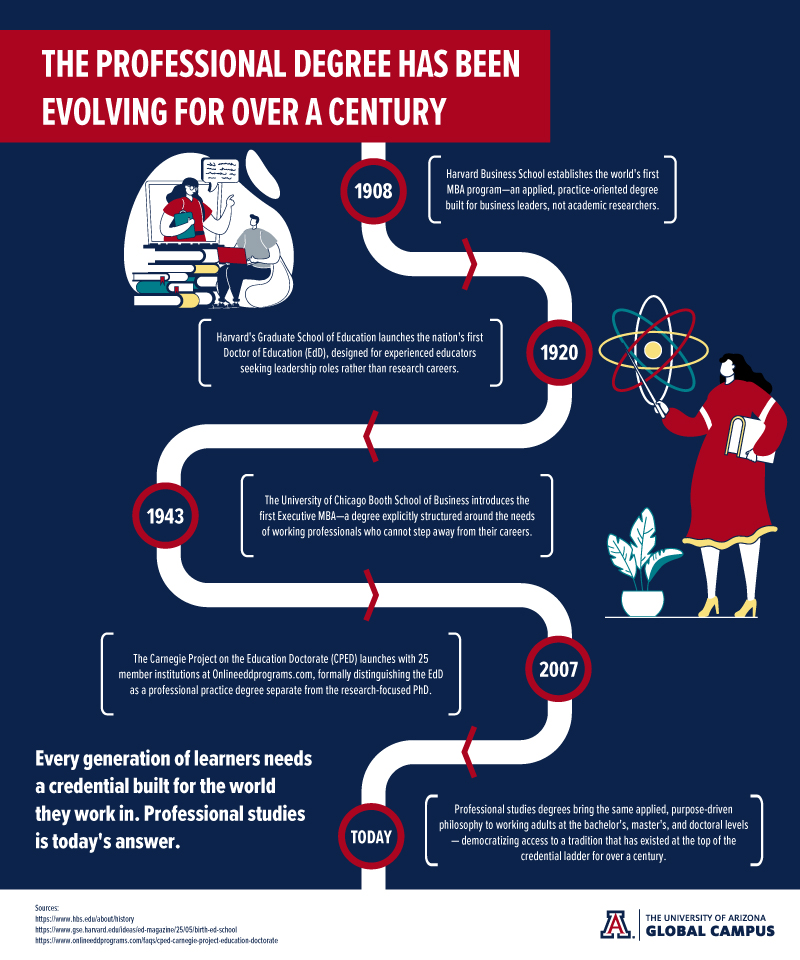
The EdD has undergone the same deliberate reframing. The Carnegie Project on the Education Doctorate (CPED) — an international collaborative network of over 160 schools and colleges of education — exists specifically to transform the EdD to be more practical and applied, making it rigorous and directly relevant to real-world challenges, and equipping graduates with the skills and knowledge to drive meaningful improvements in their field.
As CPED defines it, "the professional doctorate in education prepares educators for the application of appropriate and specific practices, the generation of new knowledge, and for the stewardship of the profession."
Professional studies degrees sit squarely within this same tradition. They are the natural extension of a model that higher education has always embraced: credentials defined not by a single subject area but by a clear professional purpose. The degree title signals intent: preparing learners to move forward in careers, apply knowledge in context, and lead in complex, real-world environments.
What makes the UAGC professional studies degrees distinctive is that they bring this applied, purpose-driven philosophy to working adults at multiple degree levels — democratizing access to the kind of rigorous, practice-oriented education that has long existed at the top of the credential ladder. In that light, professional studies isn't a departure from academic tradition. It's a continuation of it.
Frequently Asked Questions (FAQ)
- What Is a Professional Studies Degree?
A professional studies degree is a career-focused, interdisciplinary program designed to develop applied skills, industry-aligned competencies, and real-world experience. It prepares students for professional roles by emphasizing practical knowledge over purely theoretical study. - Is Professional Studies a Major?
No. Professional studies is a degree type or classification, not a single major. Within the degree, students may select a specific focus or area of study, while the overarching program emphasizes applied learning and career readiness. - Who Benefits Most from a Professional Studies Degree?
Working adults, career changers, transfer students, and lifelong learners often benefit the most from earning a professional studies degree. The flexibility, applied focus, and industry relevance of these programs make them ideal for students balancing education with careers or other life commitments. - How Does a Professional Studies Degree Differ from Traditional Degrees?
Traditional degrees often focus on theory, research, or broad academic exploration, whereas professional studies degrees prioritize practical, workplace-ready skills and interdisciplinary problem-solving. This approach is built to meet the demands of today’s rapidly evolving workforce. - Are Professional Studies Degrees Respected by Employers?
Yes, professional studies degrees are respected by employers. Employers increasingly value skills, applied learning, and adaptability — all core aspects of professional studies programs. The degree demonstrates practical readiness and the ability to navigate complex, real-world challenges. - Can a Professional Studies Degree Lead to Graduate Studies?
Yes, a professional studies bachelor’s degree can lead to graduate studies. Similar to other bachelor’s degrees, professional studies programs can exist at the bachelor’s, master’s, and doctoral levels, and they provide rigorous, applied preparation that can support further academic pursuits or advanced professional credentials. - Is a Professional Studies Degree Right for Me?
If you are seeking a purpose-driven, flexible, and career-oriented program that allows you to gain meaningful skills without stepping away from your current life or career, a professional studies degree may be a strong fit. It’s particularly valuable for students seeking practical application and real-world outcomes.
Overview: Is a Professional Studies Degree Right for You?
The world of work has changed — and the credentials that prepare people for it are changing, too. A professional studies degree represents something higher education has always valued at its best: purposeful, rigorous preparation for the real world.
Whether you're a working adult looking to move forward, a career changer seeking a fresh start, or a motivated learner who wants a credential that reflects what you can actually do, a professional studies degree offers a clear, structured path in the right direction. It's not a compromise on academic quality — it's a deliberate choice to pursue education that meets you where you are and prepares you for where you're going.
The evidence is compelling. Employers are demanding cross-functional thinkers. Industries are rewarding adaptability over narrow specialization. And the most respected professional credentials in higher education — from the MD to the EdD — have always been defined by their practical purpose, not their theoretical depth.
At UAGC, professional studies degrees are built on that same foundation. Applied learning. Industry-relevant competencies. Real-world outcomes. And the flexibility to pursue all of it without stepping away from the career, family, and life you've already built.
The question isn't whether a professional studies degree is legitimate. The question is whether you're ready to move forward. If the answer is yes, UAGC is ready to help you get there.