Serving in the U.S. military requires commitment, discipline, and sacrifice. After service, or even during, many active-duty members and veterans look for ways to build the next chapter of their lives. For some, that means going back to school.
If this sounds like you, there is good news. Your service may have already earned you education benefits through the GI Bill®.
The GI Bill® helps veterans, active-duty service members, and some family members pay for college or training programs. These benefits can help cover tuition, housing, and other school costs.
If you are thinking about earning an associate, bachelor’s, master’s, or doctoral degree, understanding how the GI Bill® works can help you make the most of the benefits you earned.
This guide explains what the GI Bill® is, the difference between major GI Bill® programs, and how you can use your benefits at the University of Arizona Global Campus (UAGC).
Your next mission starts here.
What is the GI Bill®? History and Benefits
In short, the GI Bill® is an education benefit provided by the U.S. Department of Veterans Affairs (VA).
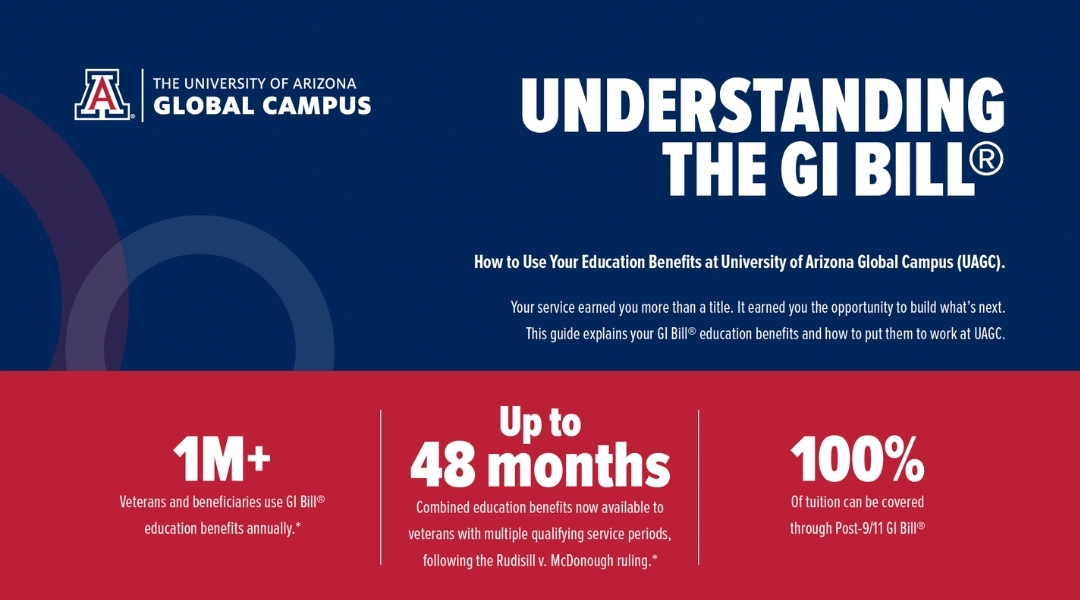
In 1944, President Franklin Delano Roosevelt signed Public Law 78-346, the Servicemen’s Readjustment Act of 1944, which provided sweeping new benefits to World War II veterans. Eight decades later, the bill’s modern version, referred to as the “GI Bill®,” continues to serve as one of the most powerful tools for veterans to gain skills, degrees and credentials that align with the evolving demands of the U.S. economy.
Today, the GI Bill® helps eligible veterans, service members, and some family members pay for education or job training. Depending on the program, the GI Bill® may help cover:
- Tuition and fees
- Books and supplies
- Certain training or certification programs
Several versions of the GI Billl® exist, but the most well-known is the Post-9/11 GI Bill®. Here’s how it works.
What Is the Post-9/11 GI Bill®?
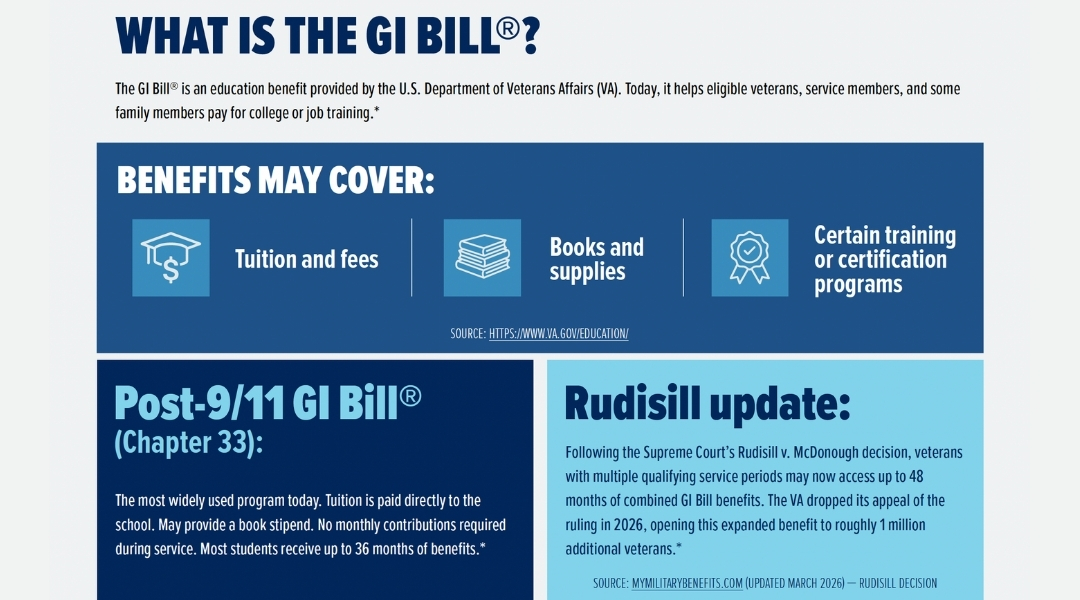
The Post-9/11 GI Bill® program, or Chapter 33, provides education benefits and is the most widely used program today. Key features of the Post-9/11 GI Bill® program include:
- Tuition is paid directly to the school
- May provide money for books and supplies
- Does not require monthly contributions during service
Most students receive up to 36 months of education benefits, although some may qualify for more depending on their service history.
Do I qualify for the Post-9/11 GI Bill®?
You may qualify for the Post-9/11 GI Bill® if you served on active duty after September 10, 2001.
When applying through the VA for your benefits, you will need your Social Security number and military service records to confirm eligibility. In the VA application, you will also need to provide your school’s information and your banking details to set up automatic deposits for any payments sent directly to you.
Key 2025 update: Following the Supreme Court’s decision in Rudisill v. McDonough, veterans with multiple qualifying service periods may now access up to 48 months of combined education benefits if they qualify for the Post-9/11 GI Bill®.
Benefit Expiration Dates: Veterans have 15 years after separation from the military to use the Post-9/11 GI Bill®, though the Forever GI Bill® has eliminated this limit for those discharged after January 1, 2013.
Using the GI Bill® for Online Learning
Many veterans choose online programs because they offer flexibility. Online learning can make it easier to balance school with work, family responsibilities, or continued military service.
If you use the Post-9/11 GI Bill® for online-only classes, the amount works the same as in-person courses.
Your exact payment may vary depending on:
- Your GI Bill® eligibility percentage
- Your enrollment level (full time or part time)
- Your rate of pursuit in your program
The rate of monthly housing allowance (MHA) may differ for online courses, as the VA bases the rate on the national average. The VA will pay equal to half the national average for MHA for online courses.
Online programs can provide strong educational value and flexibility. Understanding how housing allowances work can help you plan your finances while earning your degree.
How Is the GI Bill® Applied at UAGC?
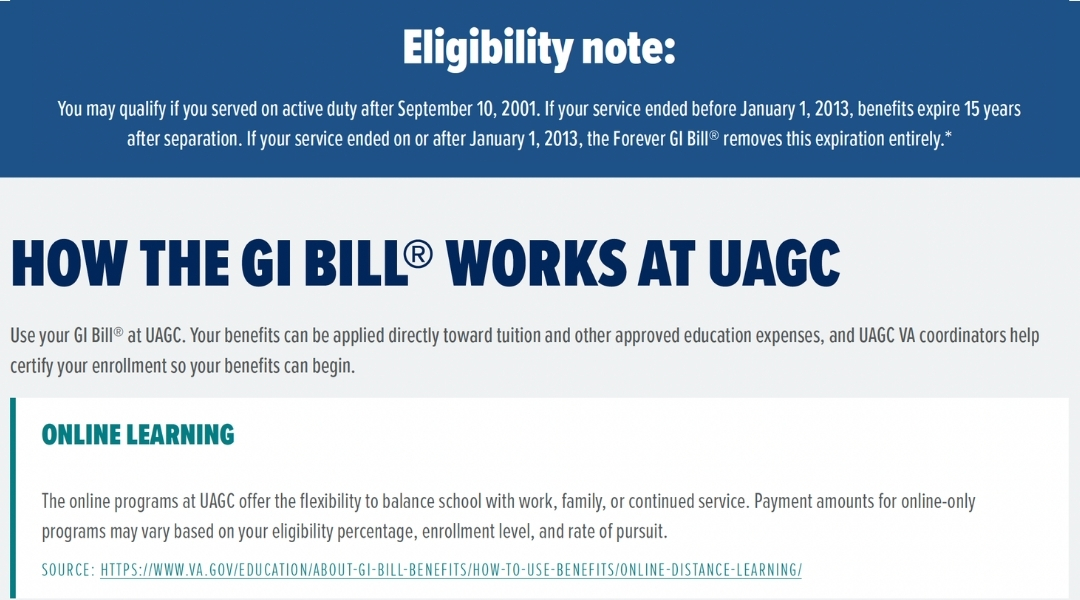
Students who qualify for GI Bill® benefits can apply those benefits directly toward their education at the University of Arizona Global Campus.
At UAGC, GI Bill® benefits may help cover tuition and other approved education expenses.
Can My Spouse Receive Education Benefits?
If you’re a qualified service member, you may be able to transfer all 36 months or a portion of your Post-9/11 GI Bill benefits to a spouse or child. The Department of War approves a transfer of benefits.
Eligibility depends on several factors, including:
- Length of military service
- Current service status
- An agreement to add more years of service
- Department of War approval for benefit transfer through milConnect
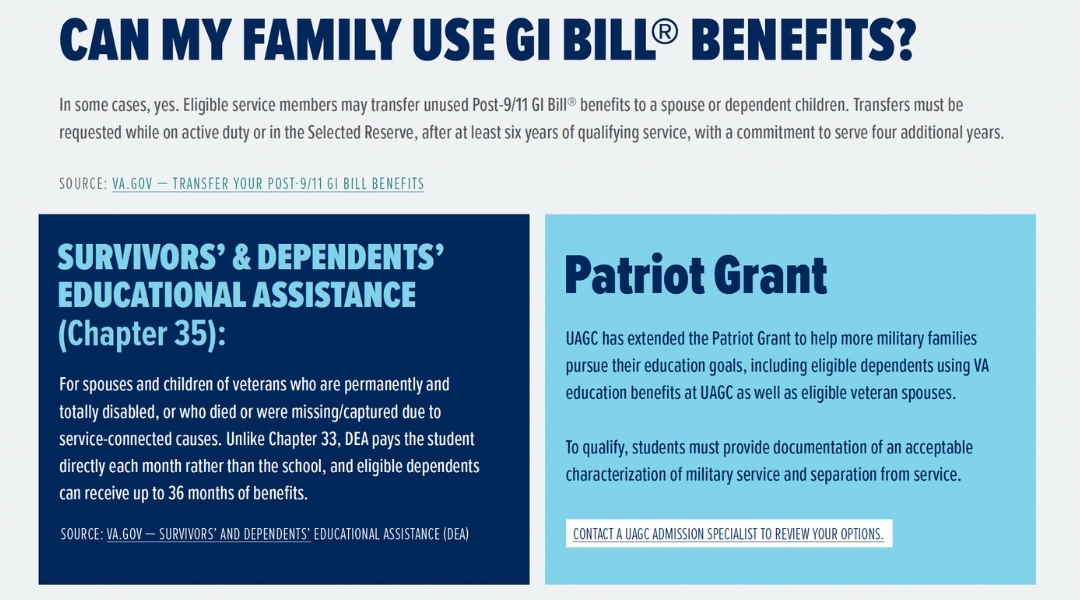
If you are considering transferring benefits, it is best to review the requirements through the VA or speak to a dedicated Veteran Affairs Specialist who will guide you through the process and assist with any questions you may have.
UAGC Patriot Grant for Spouses
UAGC recognizes the sacrifices military families make as a military spouse or dependent. We understand the unique challenges that come with being a military spouse, and we are dedicated to providing your family with the flexibility and resources you need to pursue your personal passions while balancing military life, including the Patriot Grant, which has been extended to spouses of veterans, It is also extended to other dependents who are utilizing veteran benefits.
Conclusion
The GI Bill® was created to help veterans transition into civilian life, build new careers, and support their families.
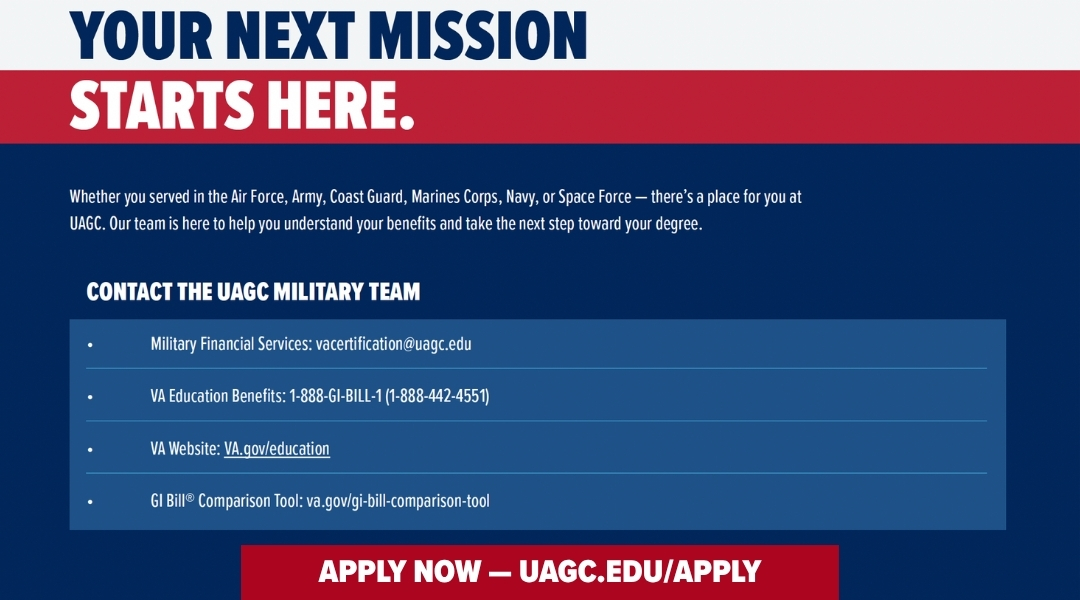
Whether you have served in the U.S. Air Force, Army, Coast Guard, Marines, Navy or Space Force, there is a place for you at UAGC.
Here, you have the opportunity to finish a bachelor’s degree, pursue a master’s degree, or explore a new career path. Understanding your GI Bill® benefits is an important first step.
Work with an advisor who understands the process and can help guide them through using their benefits.
How to Apply
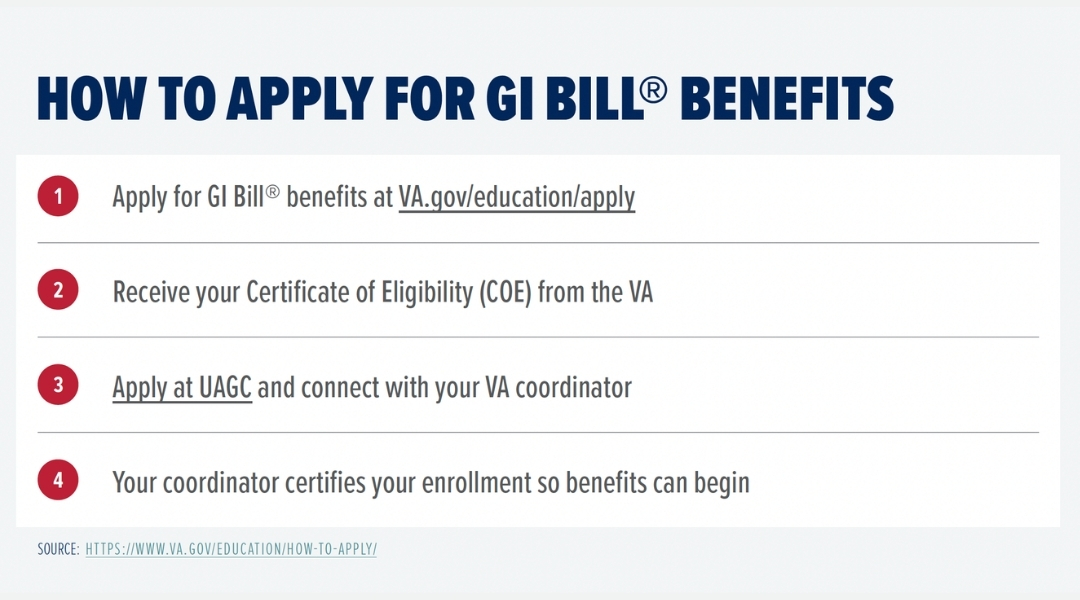
If you want to use your GI Bill® benefits for school, the process usually includes these steps:
- Apply for GI Bill® benefits through the VA.
Submit your application through the VA website. - Receive your Certificate of Eligibility (COE).
The VA will review your service record and confirm your benefits. - Choose a GI Bill®-approved school.
Schools like UAGC have staff who help certify GI Bill® benefits. - Work with a VA Coordinator
Your UAGC VA coordinator helps report your enrollment to the VA so your benefits can begin.
You can also use the VA’s GI Bill® Comparison Tool to estimate your benefits and review schools. Learn more on how to apply here.
Important Notice: Financial Oversight Disclosure
UAGC is currently under Heightened Cash Monitoring (HCM) by the U.S. Department of Education. This appears as a "Caution Flag" on the VA GI Bill Comparison Tool.
- What this means: This is an administrative oversight process related to federal aid. It is often triggered by institutional transitions or reporting requirements.
- Impact on your GI Bill: This flag does not affect your GI Bill. These benefits are managed by the VA and are not impacted by this Department of Education status.
- School Status: UAGC remains accredited and eligible to serve veterans and provide federal financial aid.
For questions, please contact the UAGC Military & Veteran Financial Aid Office.
Frequently Asked Questions
Q: Do Active-Duty Members and Veterans Have the Same Benefits?
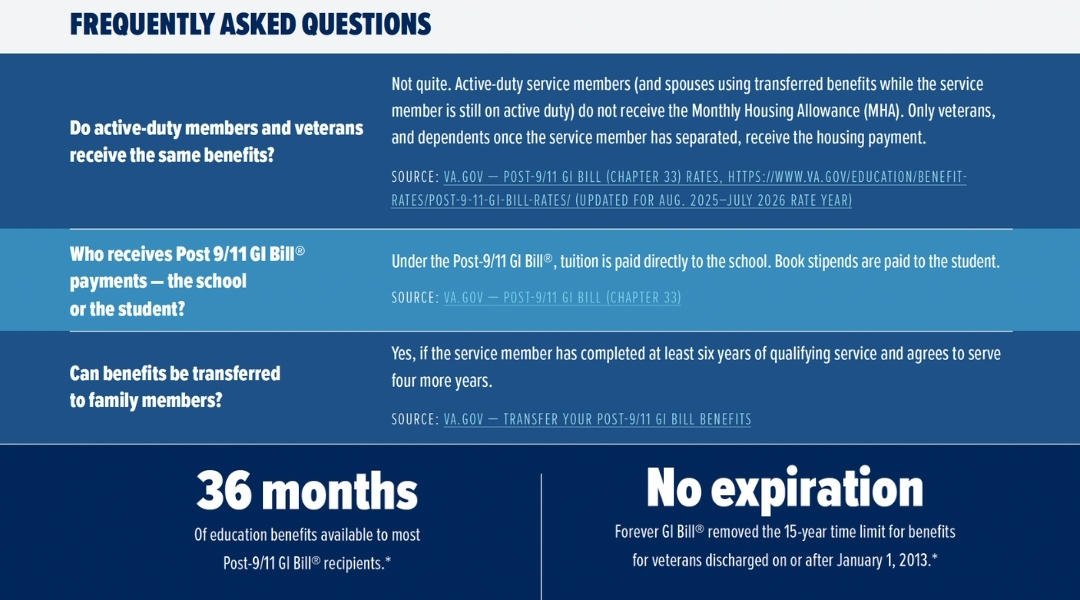
A: The tuition benefit is the same for active-duty members and Veterans using the GI Bill®. However, unlike veterans, active-duty members will not receive the Monthly Housing Allowance (MHA) associated with Post 9/11 which is a housing stipend. Active-duty Service Members will continue to receive any Department of War Basic Allowance for Housing (BAH) which is aa benefit unrelated to veteran benefits.
Active-duty service members can transfer their GI Bill® benefits to their dependents. They must do this while on active duty and can only begin the process after serving for at least six years. They must commit to staying in the military for another four years in order to transfer their eligibility. They can split their months of eligibility between multiple dependents.
Q: How long do GI Bill® benefits last?
A: Most students receive up to 36 months of benefits, though some may qualify for up to 48 months depending on eligibility.
Q: Do GI Bill® benefits cover the full cost of college?
A: The various GI Bills® and other veteran benefit programs have differing rates of payment. Factors such as the level and length of the program, the type of school, and your own eligibility rates will impact how the benefits apply. To understand your eligibility and how it will apply, you should visit the VA Education website and utilize the GI Bill® Comparison Tool.
Q: Do I receive money directly?
A: Under the Post-9/11 GI Bill®, tuition is usually paid directly to the school. Housing allowances and book stipends may be paid to the student.
Q: Can active duty service members use the GI Bill®?
A: Yes. Many active duty service members qualify for GI Bill® benefits after meeting service requirements.
Q: Can benefits be transferred to family members?
A: In some cases, yes. Eligible service members may transfer unused benefits to a spouse or children.
Q: What happens if I’m called to active duty while I’m enrolled?
A: UAGC has Military Deployment Provisions to support students who are called to state or federal service. These protections help ensure military-connected students are not academically or financially disadvantaged because of deployment. Depending on the situation, students may have several options. Students can find the required forms for Military Withdrawal or Military Course Drop in myUAGC, making it easier to request support during deployment.
Q: Who receives GI Bill® payments — the school or the student?
A: It depends on the program. Under the Post-9/11 GI Bill®, tuition and fees are usually paid directly to the school. Book stipends are paid to the student.
Q: What is the difference between VA education benefits?
A: The main difference between Chapter 30, Chapter 33, and Chapter 35 is who the benefit is for and how the payments are made.
Chapter 30 (Montgomery GI Bill Active Duty): This benefit is earned through your own qualifying military service. The VA pays a monthly education benefit directly to the student based on their enrollment status. The VA does not pay tuition and fees directly to UAGC, leaving it to the student's responsibility to pay the school.
Chapter 33 (Post-9/11 GI Bill®): This is earned through your own service or transferred to you by a service member. The VA pays your tuition and fees directly to UAGC. You also receive a yearly stipend for books and supplies paid directly to you.
Chapter 35 (Survivors’ and Dependents’ Educational Assistance - DEA): This is specifically for the spouses and children of veterans who are permanently and totally disabled or deceased due to a service-connected condition. Unlike Chapter 33, the VA does not pay the school directly. Instead, the student receives a fixed monthly payment to use toward tuition, housing, and books as they see fit.
Q: Do I qualify for Chapter 35?
A: To qualify for the Survivors’ and Dependents’ Educational Assistance (DEA) program, also known as Chapter 35, both you and the Veteran or service member must meet specific criteria.
- Sponsor Requirements: The Veteran or service member must be permanently and totally disabled, died from a service-connected condition, died in the line of duty, or be MIA/captured.
- Applicant Requirements: You must be the spouse or child of the veteran. Children are generally eligible if they’ve turned 18 after August 1, 2023. Spouses generally have 10 years of eligibility, which may extend to 20 years in certain cases.
Need More Information?
Connect with the UAGC Military Team
Military Financial Services: vacertification@uagc.edu
VA Education Benefits
Call: 1-888-GI-BILL-1 (1-888-442-4551)
Website: VA.gov/education
GI Bill® Comparison Tool: Check out va.gov/gi-bill-comparison-tool.
Request free transcript: jst.doded.mil.
Online application: VA.gov/education/apply.
--
GI Bill® is a registered trademark of the U.S. Department of Veterans Affairs (VA). More information about education benefits offered by VA is available at the official U.S. government Web site at http://www.benefits.va.gov/gibill.