Key Takeaways
- A Master of Professional Studies (MPS) degree is a career-focused graduate program centered on practical, real-world application.
- MPS programs are commonly designed for working professionals, adult learners, and career changers.
- Unlike research-heavy master’s degree programs, MPS degrees often emphasize specialized projects, leadership development, and industry-specific training.
- Popular MPS concentrations include leadership, cybersecurity, data analytics, health care administration, project management, HR, and digital marketing.
- Many MPS programs are offered online or in flexible formats to accommodate full-time professionals.
- MPS degrees differ from MBAs, Master of Science and Master of Arts in their balance of specialization, professional skill development, and workplace application.
- The growth of MPS programs reflects increasing demand for workforce-aligned graduate education and flexible learning pathways.
What Is an MPS Degree? Master of Professional Studies Degree Guide
Graduate education is evolving–with that comes the Master of Professional Studies. Today’s professionals are increasingly seeking degree programs that provide practical, career-relevant skills. They want flexible learning options and clear connections to the impact they have on the workforce, rather than programs focused solely on academic theory. The OECD highlights that adult learners pursue education to keep skills current, to adapt to changing workforce needs, and to improve career outcomes. It also notes the importance of flexible learning opportunities that fit adults’ work and life responsibilities. That shift has helped fuel growing interest in the Master of Professional Studies, or MPS degree.
An MPS degree is designed to bridge the gap between classroom learning and real-world application. Unlike traditional research-focused master’s degree programs, MPS programs emphasize hands-on training, leadership development, and industry-specific expertise that students can immediately apply in the workplace. Many programs are built with working adults in mind, offering online formats that allow students to continue moving forward in their careers while earning a graduate degree.
From leadership and data analytics to cybersecurity and health care administration, MPS degrees span a wide range of industries and professional fields built to help professionals grow their leadership skills. But exactly what is an MPS degree, and how does it compare to options like an MBA, Master of Science, or Master of Arts?
In this guide, we’ll break down what an MPS degree is, who it’s best suited for, the types of careers it can support, and whether it may be the right next step for your goals.
What Does MPS Stand For?
MPS stands for Master of Professional Studies. It is a graduate degree designed to help students build practical, career-ready skills that can be leveraged directly in professional settings. While traditional master’s degree programs often emphasize academic theory or research, MPS programs are typically centered on hands-on learning, industry application, and workforce readiness.
What Is an MPS Degree?
A Master of Professional Studies is a specialized graduate degree built around professional development and industry preparation. Its primary goal is to help students strengthen the skills employers are actively seeking while gaining expertise in a specific career field. Additionally, there are several important qualities that help these programs stand out from other master’s programs, including that they are:
- Direct. An MPS program can offer a more direct pathway to career growth for professionals who already have work experience. Many students pursue the degree to qualify for other roles, such as management positions. They may also want to build specialized technical knowledge within their area of expertise and define their niche. According to Indeed's Career Guide, graduate education can help professionals increase earning potential, improve job competitiveness, and develop advanced knowledge valued by employers.
- Flexible. The degree is also known for its flexibility. Like many professional graduate programs, MPS degrees are frequently offered in online formats, which can make them appealing to adult learners and full-time professionals balancing work, family, and education. Research on online adult learners shows that flexibility and the ability to integrate education with existing responsibilities are major factors influencing how working adults pursue additional education. Forbes notes that flexible graduate programs have become an important option for professionals seeking career mobility without stepping away from the workforce entirely. Further, according to U.S. News, flexible graduate education options can help professionals balance academic goals alongside work and personal responsibilities.
- Tailored to Your Interests: Another major distinction is the structure of the curriculum itself. MPS programs often combine industry-specific instruction with broader professional skills such as:
- Leadership and team management
- Communication and presentation skills
- Strategic decision-making
- Project planning
- Data interpretation
- Organizational problem-solving
This combination helps graduates prepare not only for technical roles but also for positions that require collaboration, oversight, and business awareness. The degree has become especially popular in industries experiencing rapid change, where employers need professionals who can adapt quickly and apply new knowledge immediately.
Why Study a Master of Professional Studies?
For professionals seeking specialized skills without leaving the workforce, an MPS offers a blend of advanced education and practical application. The degree’s emphasis on industry knowledge, practical projects, and professional development makes it a strong option for those looking to make a career change.
What Can You Study in an MPS Program?
One of the biggest advantages of an MPS degree is its versatility. Unlike some graduate programs that focus narrowly on a single academic discipline, MPS programs are often designed around emerging industries, workforce needs, and specialized professional skills. This allows students to pursue advanced education in fields that are directly tied to current job market demands.
Because MPS programs are career-oriented, concentrations are typically aligned with industries experiencing rapid growth or transformation. Many programs also combine technical knowledge with leadership and management training, helping graduates prepare for both specialist and supervisory roles.
Some of the most common MPS specializations include areas such as:
- Leadership: Leadership-focused MPS programs help students develop the skills needed to guide teams, manage organizational change, make strategic decisions, and improve workplace performance.
- Data Analytics: Students in data analytics programs learn how to interpret complex data, identify trends, and support business decision-making. Cybersecurity: Cybersecurity-focused MPS programs prepare students to protect organizations from digital threats and security breaches.
- Project Management: Project management programs emphasize leadership, operations, budgeting, scheduling, and team coordination.
- Health Care Administration: Health Care-focused MPS programs often combine health care systems knowledge with business and leadership training. Human Resources: Human resources concentrations focus on talent management, organizational behavior, recruitment, employee relations, and workplace strategy.
- Digital Marketing and Communications: These programs help students build expertise in social media strategy, content marketing, branding, analytics, and digital communication tools.
- Sustainability and Environmental Management: Sustainability-focused programs prepare students to address environmental, social, and governance (ESG) challenges within organizations.
Who Should Consider an MPS Degree?
An MPS degree can be a strong fit for professionals who want a graduate education that is closely connected to workplace skills and career enhancement. Because these programs are designed with practical application in mind, they often appeal to students looking for flexibility, specialization, and direct professional outcomes rather than a traditional academic experience.
While every student’s goals are different, several groups tend to benefit most from MPS programs. These include:
- Working Professionals Seeking Enhancement Many MPS students are already established in their careers and want to move into leadership or different roles altogether. An MPS degree can help professionals deepen expertise, strengthen management skills, and remain competitive in rapidly evolving industries. Because MPS programs are often designed for working adults, students can frequently continue working while completing coursework.
- Career Changers Professionals transitioning into a new industry may also find the MPS especially valuable. Many programs are structured to provide focused, industry-specific training without requiring students to pursue a highly theoretical or research-heavy graduate path. For example, someone with a background in business operations may pursue an MPS in data analytics, cybersecurity, or health care administration to build specialized expertise that aligns with a new career direction.
- Students Interested in Applied Learning MPS programs may appeal to learners who prefer solving real-world problems over completing primarily theoretical coursework. Through projects, case studies, and workplace applications, students can connect academic concepts to professional challenges. This applied structure can appeal to learners who want to develop immediately usable workplace skills and see direct connections between coursework and professional responsibilities.
- Adult Learners Returning to School Professionals returning to education may seek programs that recognize prior experience–through previous education, military service, and other means–and want to connect learning directly to career goals. MPS programs can provide a structured way to gain advanced credentials without stepping away from professional responsibilities. Online learning continues to grow in popularity among adult students seeking convenience and accessibility. MPS programs often reflect this shift by prioritizing flexibility and accessibility alongside academic rigor.
- Professionals in Fast-Changing Industries MPS programs are often designed to respond to emerging workforce needs more rapidly than traditional academic programs.
For professionals working in dynamic fields, this career-focused curriculum can provide an opportunity to stay current with industry trends, technologies, and leadership expectations.
Ultimately, the ideal MPS student is someone looking for education with a clear professional purpose. Whether the goal is career enhancement, specialization, leadership development, or industry transition, the degree is designed to connect advanced learning with skills you can apply immediately to your career.
MPS vs. MBA vs. MS vs. MA: What’s the Difference?
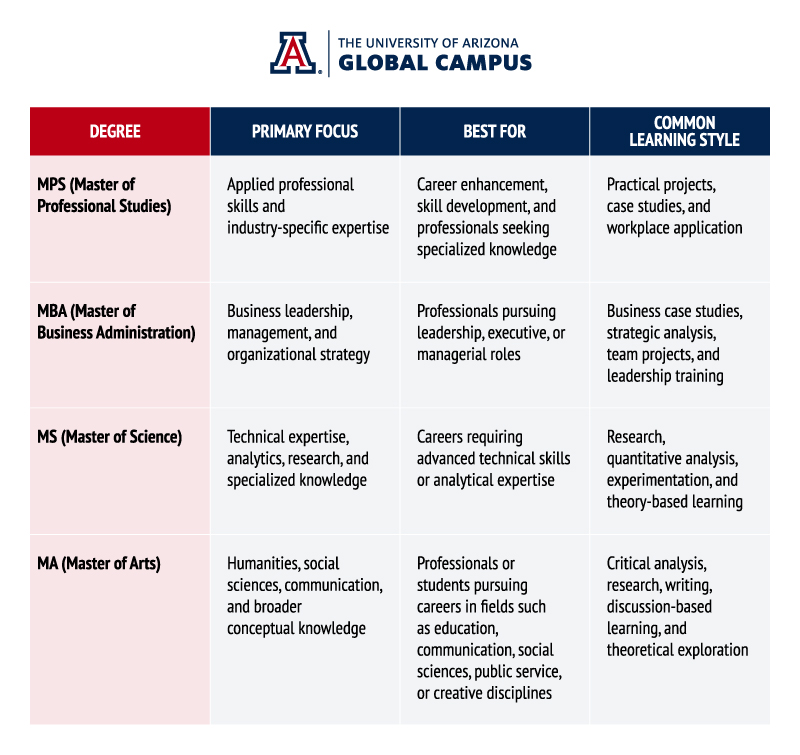
For prospective graduate students, one of the biggest questions is often which type of master’s degree best fits their goals. While an MPS, MBA, Master of Science (MS), and Master of Arts (MA) can all support career mobility, they are designed for different purposes and learning outcomes.
Understanding these distinctions can help students choose a program that aligns with their professional interests, preferred learning style, and long-term career plans.
MPS: Career-Oriented and Focused An MPS degree is primarily designed for practical, workforce-oriented learning. Programs concentrate on industry application, professional skills, and leadership development rather than academic research.
Students in MPS programs often complete:
- Applied projects
- Capstone experiences
- Industry case studies
- Collaborative assignments
- Real-world problem-solving exercises
The degree is especially well suited for professionals seeking specialized expertise within a specific field such as cybersecurity, project management, healthcare administration, or digital marketing.
MBA: Broad Business and Leadership Training A Master of Business Administration (MBA) is focused more broadly on business management and organizational leadership. MBA programs typically cover areas such as:
- Finance
- Accounting
- Marketing
- Operations
- Strategy
- Leadership
- Economics
An MBA is often ideal for professionals pursuing executive leadership roles, management positions, or careers that require broad business knowledge across industries. MBA programs tend to prioritize leadership, management, and business decision-making, while other specialized master’s degrees focus more deeply on a particular subject area.
MS: Technical and Research-Oriented A Master of Science (MS) degree is generally more academic and specialized than an MPS or MBA. MS programs often emphasize:
- Technical mastery
- Scientific or analytical methods
- Research skills
- Quantitative analysis
- Thesis or research projects
Students pursuing an MS degree may be preparing for highly technical careers, research positions, or doctoral study. Fields commonly associated with MS degrees include computer science, engineering, biology, mathematics, and data science.
Compared to MPS programs, MS curricula may place greater emphasis on theory, methodology, and academic scholarship.
MA: Humanities, Communication, and Theory-Oriented A Master of Arts (MA) degree typically focuses on broad knowledge areas related to the humanities, social sciences, communication, and other disciplines centered on human behavior, culture, and ideas.
Compared with an MPS, MBA, or MS, MA programs often emphasize:
- Critical thinking and analysis
- Communication and interpretation
- Research methods and qualitative analysis
- Theory and academic scholarship Writing, discussion, and project-based learning
Students pursuing an MA degree may be preparing for careers in fields that value strong communication, leadership, research, cultural understanding, or specialized knowledge. Common MA fields include psychology, education, communication, history, English, political science, sociology, and organizational studies.
Compared with MPS programs, MA curricula may place greater emphasis on conceptual frameworks, theory, and understanding complex social or cultural issues. While many MA programs include practical applications, the degree is often designed to develop expertise through analysis, research, and deeper exploration of a specific subject area.
Which Degree Is Right for You?
The best degree ultimately depends on a student’s career goals. An MPS may be the strongest fit for professionals who:
- Want industry-specific, applied training
- Prefer hands-on learning
- Need flexibility as working adults
- Are focused on career mobility rather than research
An MBA may be better for students seeking broad business leadership skills, while an MS may appeal to those pursuing technical expertise or academic research pathways; and an MA may be the right fit for some looking for broader, more theoretical knowledge. As graduate education becomes specialized, many professionals are choosing programs based less on prestige alone and more on how directly the curriculum supports their career objectives.
How Long Does an MPS Degree Take?
The length of an MPS program can vary depending on the school, concentration, and enrollment format, but most students complete the degree in about one to two years. Programs are often designed with flexibility in mind, making them accessible for both full-time students and working professionals.
Several factors influence how long it takes to finish an MPS degree, including:
- Transfer credits
- Program structure
- Internship or capstone requirements
- Past experiences, such as military or leadership
- Individual scheduling needs
- Online Learning Formats
A defining feature of many MPS programs is accessibility. Online learning formats allow students to participate in coursework without relocating or commuting to campus several days a week.
Qualities of virtual MPS programs may include:
- Asynchronous coursework students complete on their own schedule
- Online classes or discussions
- Collaborative online projects
- Networking and other opportunities to get to know faculty and peers
This flexibility can be especially valuable for professionals managing demanding work schedules or family obligations.
Final Thoughts: What Is an MPS?
Choosing a graduate degree comes down to the type of experience and outcome you want. An MPS may be the right fit for professionals seeking specialized knowledge, practical experience, and a direct connection between education and career goals. You want to learn new skills today and apply them to your career tomorrow. For those pursuing research or deeper academic research, however, an MS, MBA, or MA may better align with their path.
The MPS degree’s growing popularity also shows the broader changes in higher education and the workforce. More and more, employers value adaptable professionals who can combine technical knowledge with communication, collaboration, and strategic thinking skills. At the same time, adult learners are seeking graduate programs that fit into busy lives and deliver measurable career outcomes.
In the end, choosing a graduate degree is about finding the right fit for your career aspirations, learning preferences, and long-term goals. For students looking for a modern, practical approach to graduate education, the Master of Professional Studies represents a worthwhile path forward.
Ready to earn your Master or Professional Studies? Talk to an advisor today!