What do online learners look like, and what are online learner trends these days? What used to be the exception — online learning — has now, in many cases, become the rule. Today’s online learners are more diverse than ever — spanning ages, career stages, life circumstances, and educational goals. No longer limited to a narrow slice of students, online education now serves working professionals, parents, caregivers, military members, career changers, and first-time college students alike. Flexibility, accessibility, and relevance have reshaped who enrolls and why, turning online learning into a mainstream pathway rather than an alternative one.
As technology improves and institutions refine virtual instruction, enrollment patterns continue to evolve, and thus, so do online learner trends. Adult learners make up a growing share of online students, but younger learners are also increasingly comfortable with digital-first education. Geographic boundaries matter less, schedules are more personalized, and learners are more intentional — often choosing programs that align directly with career advancement, skill-building, or long-term mobility. Let’s dive into online learner demographics in 2026 and beyond.
Online Learner Trends: Gender Representation Is Shifting
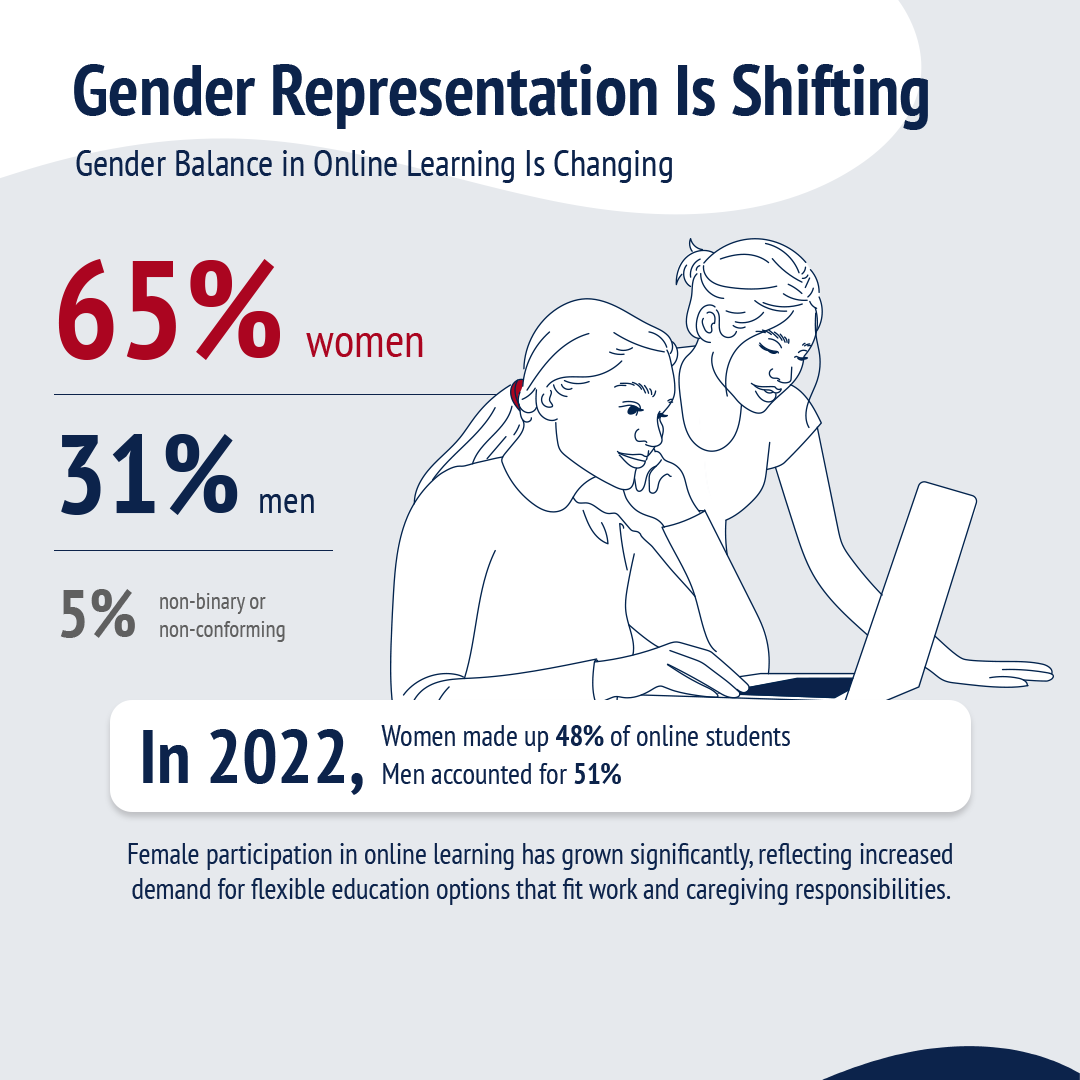
Online learning demographics have changed noticeably in recent years, particularly when it comes to gender. In a 2024 report analyzing online college students:
- 65% of online learners identified as women
- 31% as men
- 5% as non-binary or non-conforming
This marks a meaningful shift from 2022, when women made up just 48% of online students and men accounted for 51%.
This growth in female participation reflects broader trends in higher education and workforce reskilling, where women increasingly turn to flexible, online options to balance education with professional and personal responsibilities.
Age Ranges Are Broad — and Getting Younger
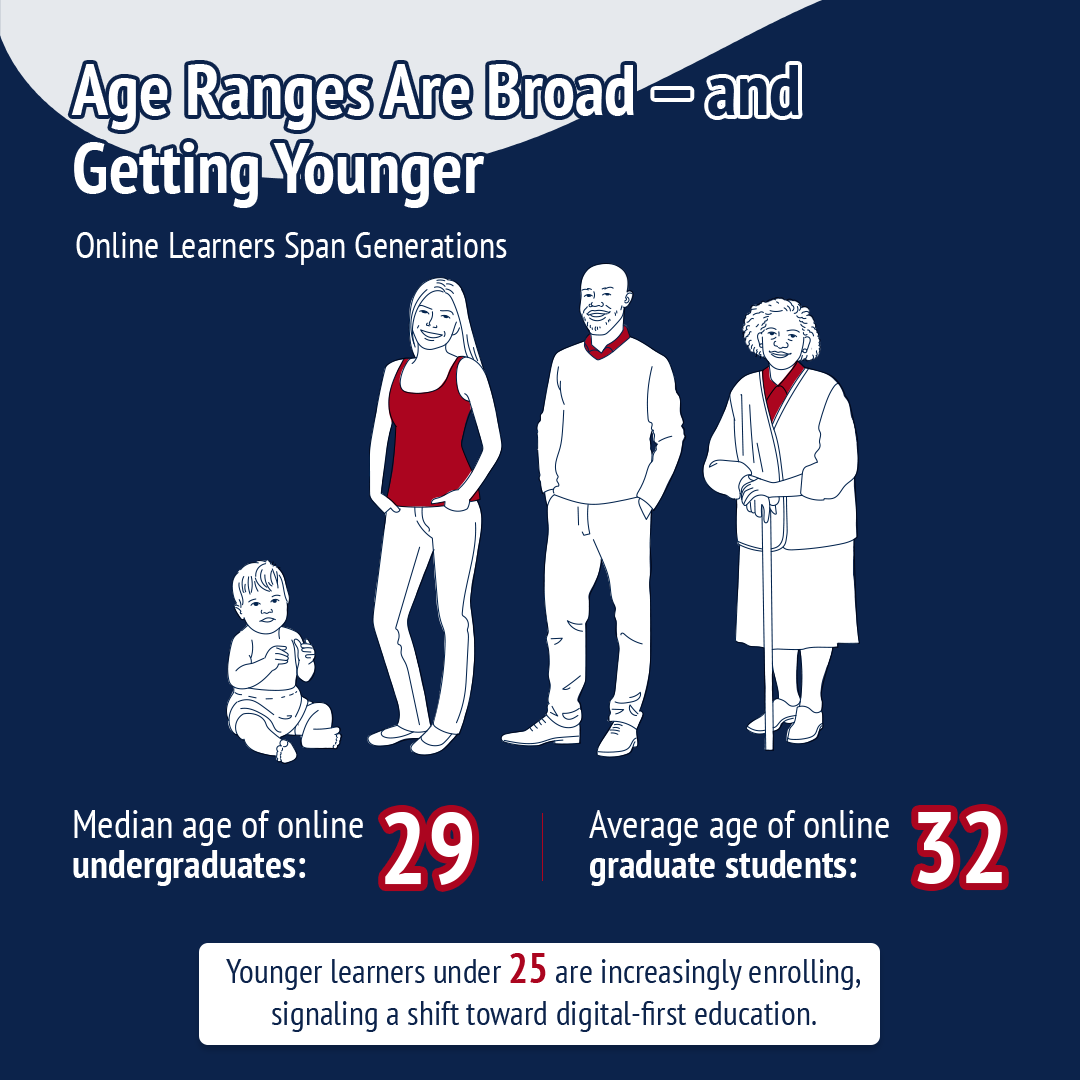
Online learners are often associated with adult and returning students, and that remains largely true. The median age of online undergraduate students is 29, while graduate students average 32. However, interestingly, the data also shows a growing number of learners under the age of 25, signaling that online education is no longer reserved primarily for mid-career adults. It’s beginning to trend younger.
Younger students, already comfortable with digital-first environments, are increasingly viewing online programs as a viable — and sometimes preferable — alternative to traditional, campus-based education.
Racial and Ethnic Composition
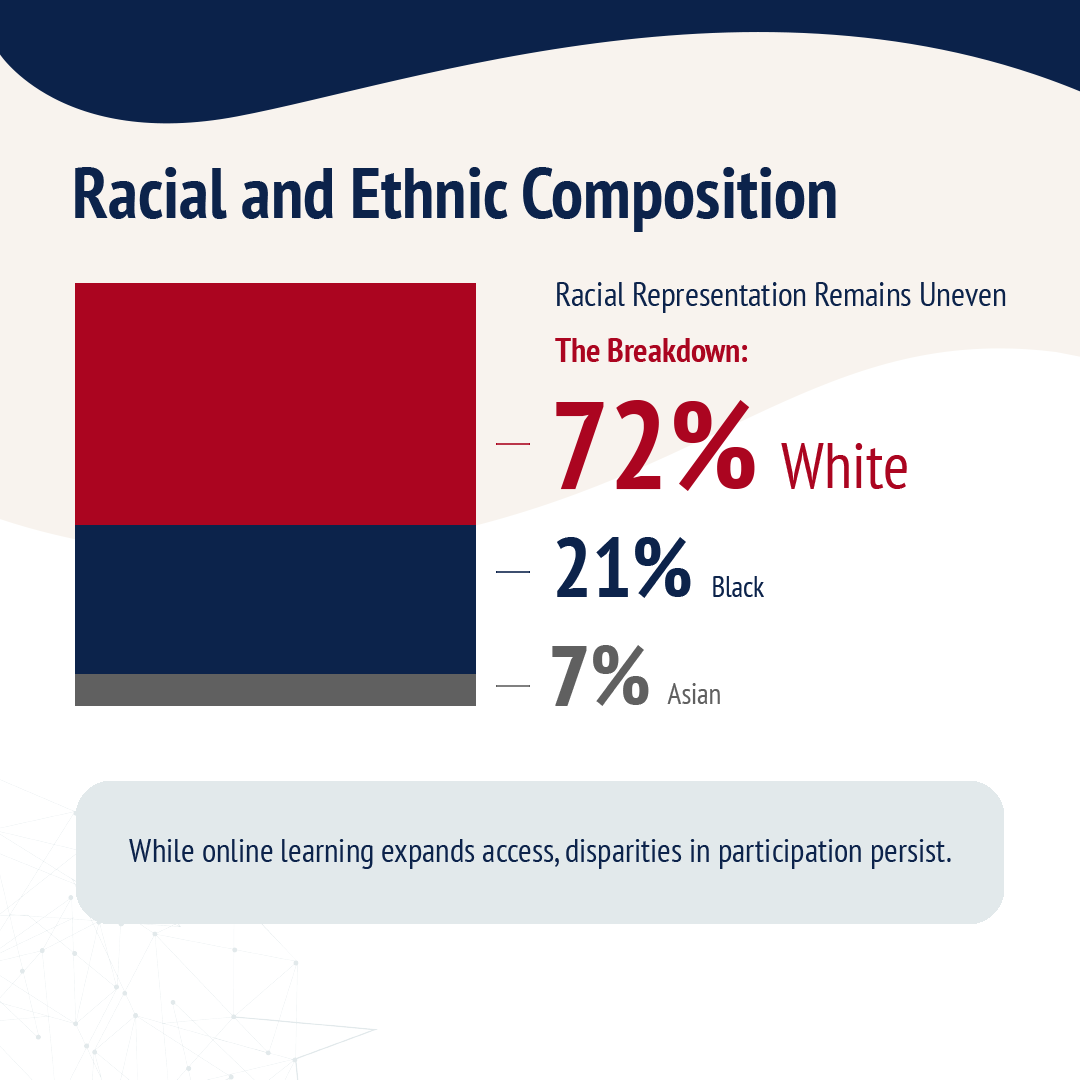
The racial makeup of online learners remains uneven. According to the same 2024 report, the online student population was:
- 72% White
- 21% Black
- and 7% Asian
While online learning has expanded access in many ways, these figures suggest ongoing disparities in participation that institutions continue to address through outreach, affordability initiatives, and student support services.
Most Online Learners Are Working Adults
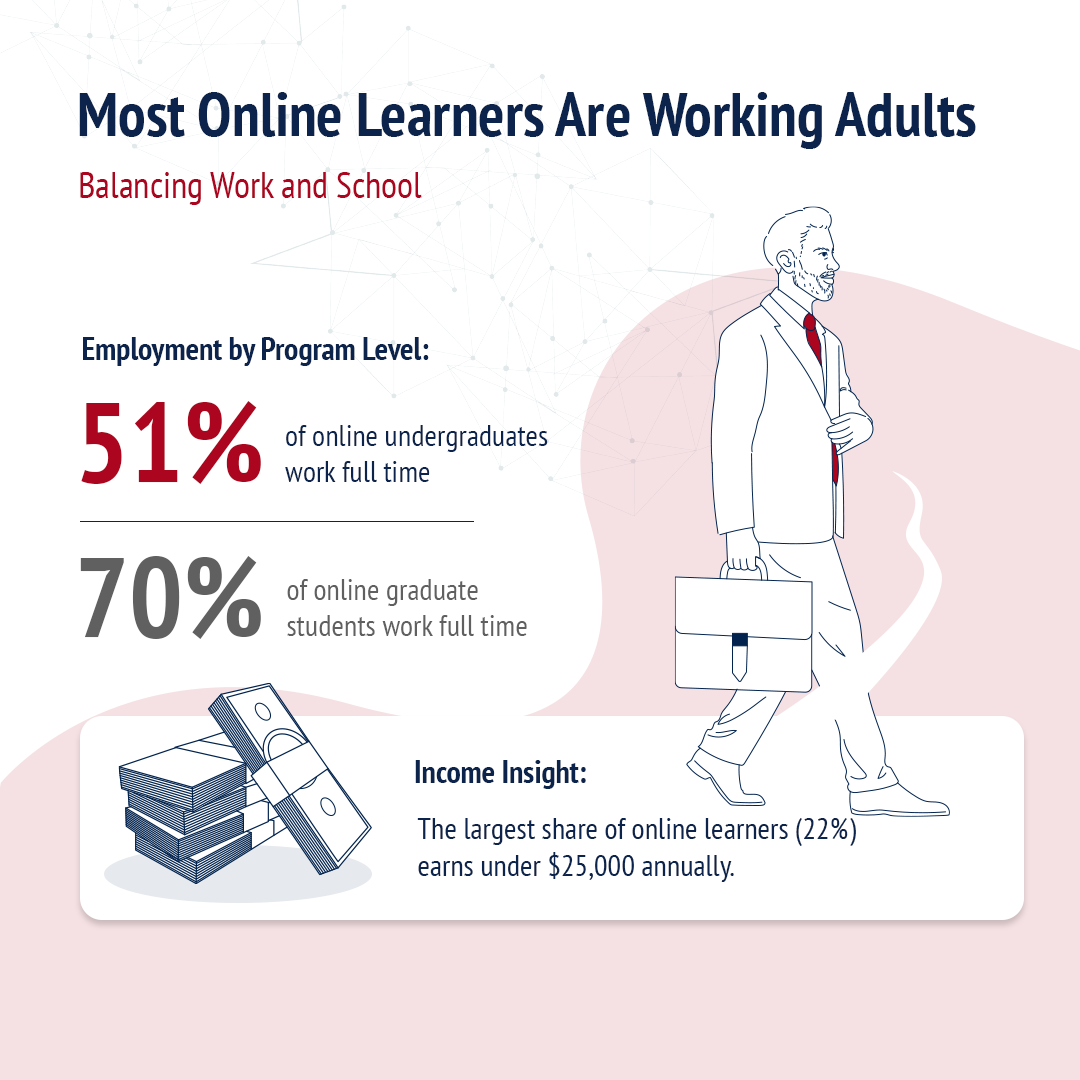
Employment status is one of the clearest defining characteristics of online learners, per the report. The majority are balancing education with full-time work:
- 51% of online undergraduates work full time
- 70% of online graduate students work full time
Income data further reinforces this picture. The largest share of online learners — 22% — earn under $25,000 annually, highlighting why flexibility, affordability, and career-relevant outcomes are critical factors in program choice.
What Online Learners Want from Their Experience
Today’s online learners have clear expectations for how education should be delivered. In 2024:
- 60% of online students said they wanted personalized content
- 56% wanted the ability to learn on demand
These preferences align with broader trends in digital experiences, where customization and convenience are increasingly seen as standard rather than optional. Beyond formal degree programs, digital learning is also becoming a routine part of everyday life. Just consider everything you quickly do a Google search for, watch a YouTube video for, or upskill in any other number of ways, from AI to podcasts. Digital learning is ubiquitous.
Why Learners Value — and Question — Online Education
Further, a 2023 McKinsey study found that 65% of students want certain aspects of learning to remain virtual, even as in-person options return. This signals a lasting shift in learner expectations: many students no longer see online education as a temporary substitute but as a permanent and valuable part of the learning experience. Virtual components — when designed well — offer efficiencies and accessibility that traditional models often cannot.
Students consistently cited several benefits of online learning:
- Access to on-demand classes: Learners value the ability to engage with coursework on their own schedules, especially those balancing work, family, or caregiving responsibilities. On-demand access allows students to learn at their own pace, revisit complex material, and study during nontraditional hours.
- Easy access to digital study materials: Centralized learning platforms make lectures, readings, assignments, and discussion boards readily available. This ease of access reduces friction, supports different learning styles, and helps students stay organized without relying on physical resources.
- The flexibility to work while pursuing education: For many online learners — especially working adults — flexibility is not a convenience but a necessity. Online programs allow students to advance their education without stepping away from full-time employment, making learning more financially and logistically feasible.
At the same time, however, hesitation remains among these students. Despite the advantages of online learning, students continue to express concerns about whether learning is the right fit for them. Students identified three main barriers to enrolling in online programs:
- Fear of being distracted while studying online: Learning from home or other non-academic environments can introduce competing demands, from household responsibilities to digital distractions.
- Lack of motivation due to boredom: Poorly designed courses or limited interaction can make online learning feel isolating or disengaging, reducing students’ intrinsic motivation.
- Concerns about maintaining discipline and completing programs: Without the structure of in-person classes, some learners worry about time management, accountability, and follow-through.
These challenges highlight the emphasis online learners place on the design of coursework, engaging classes, and student support systems. Effective online education increasingly depends on intentional instructional design, interactive learning experiences, and robust academic and personal support — factors that can make the difference between learners merely enrolling and successfully completing their programs.
Where Are Online Learners Located? | Online Learner Trends in Geography
Online learners are distributed across a wide range of community types, reflecting the broad appeal and reach of virtual education. This distribution underscores one of online learning’s defining strengths: its ability to serve students regardless of where they live. A report found the following geographic distribution:
- Roughly 45% of online learners live in suburban areas
- 32% in urban communities
- 23% in rural regions
For suburban learners, online education often complements busy professional and family schedules. These students may live near physical campuses but choose online programs for convenience, flexibility, or access to specialized offerings not available locally. Suburban learners are also more likely to balance education with full-time employment, making asynchronous coursework particularly appealing.
Urban online learners frequently turn to online education as a way to reduce commuting time, manage complex work schedules, or avoid the high cost of attending campus-based programs in densely populated areas. For these students, online learning can offer greater efficiency and affordability while still providing access to high-quality academic programs.
In rural communities, online education plays a critical role in expanding access. Learners in rural areas may face limited proximity to colleges and universities, fewer program options, and longer travel distances to campus. Online learning helps bridge these gaps by allowing rural students to pursue degrees and credentials without relocating, which is especially important for those with strong ties to their communities or local employers.
Taken together, these geographic patterns highlight how online learning adapts to different regional needs. While motivations may vary by location, the common thread is flexibility — making education accessible to learners wherever they are and reinforcing online learning’s role as a key driver of educational access and opportunity.
First-Generation College Students: A Critical Online Learner Segment
First-generation college students make up a significant and often underrecognized portion of the online learner population. Nearly 44% of online learners who returned to education after stopping early identify as first-generation college students. This trend underscores the role online programs play in reopening access to higher education for learners whose families lack prior college experience. Moreover, about 35% of online college students are the first in their families to attend college, and this group is a meaningful portion of the online population nationwide.
For many first-generation students, traditional college pathways may feel opaque or inaccessible — academically, financially, or culturally. Online learning lowers several barriers at once. Flexible scheduling allows learners to balance education with work and family obligations, while remote access removes geographic constraints that may have previously limited options. Just as important, online programs often provide clearer, more structured pathways to completion, which can be especially valuable for students navigating higher education systems without familial guidance.
However, first-generation online learners also face distinct challenges. They are more likely to juggle full-time employment, experience financial pressure, and enter programs with limited familiarity with academic norms, institutional processes, or available support services. As a result, their success is closely tied to proactive advising, clear communication, and intentional student support — from onboarding and orientation to ongoing academic coaching.
The strong representation of first-generation students among returning online learners highlights a broader trend: online education is not only expanding access, but it’s also serving as a reentry point for learners who were previously left behind.
Among undergraduate student veterans, a large majority — about 72% — take at least some courses online, highlighting how strongly this population gravitates toward flexible learning formats. For many veterans, education is pursued alongside employment, family responsibilities, and ongoing transitions back into civilian life. Online learning offers a practical pathway that accommodates these realities in ways traditional, campus-based programs often cannot.
Student veterans are more likely than traditional students to be older, financially independent, and working while enrolled, frequently full time. Some may also be balancing caregiving responsibilities or managing service-connected health needs. Online modalities allow these learners to structure coursework around unpredictable schedules, reduce commuting time, and maintain continuity in their education even when life circumstances change.
Mobility is another key factor. Veterans and military-connected learners may relocate due to employment opportunities, family needs, or continued service commitments. Online programs minimize disruption by allowing students to remain enrolled regardless of geography, ensuring progress toward a degree or credential is not derailed by moves or deployments.
At the same time, student veterans bring strong self-discipline, goal orientation, and real-world experience to online classrooms — traits that can translate into academic success when paired with appropriate support. Clear course structure, consistent communication, and access to veteran-specific resources such as advising, benefits navigation, and peer communities are especially important for this group.
The high participation of student veterans in online learning underscores a broader point: online education is not just a matter of convenience, but a critical access pathway for learners whose lives do not align with traditional academic timelines. For military-connected students in particular, online programs can serve as a stabilizing force — providing continuity, opportunity, and a clear route toward long-term career and educational goals.
Online Learner Trends in Employment
Online learners today are overwhelmingly shaped by their connection to the workforce. According to Whiteboard Advisors’ post-pandemic survey:
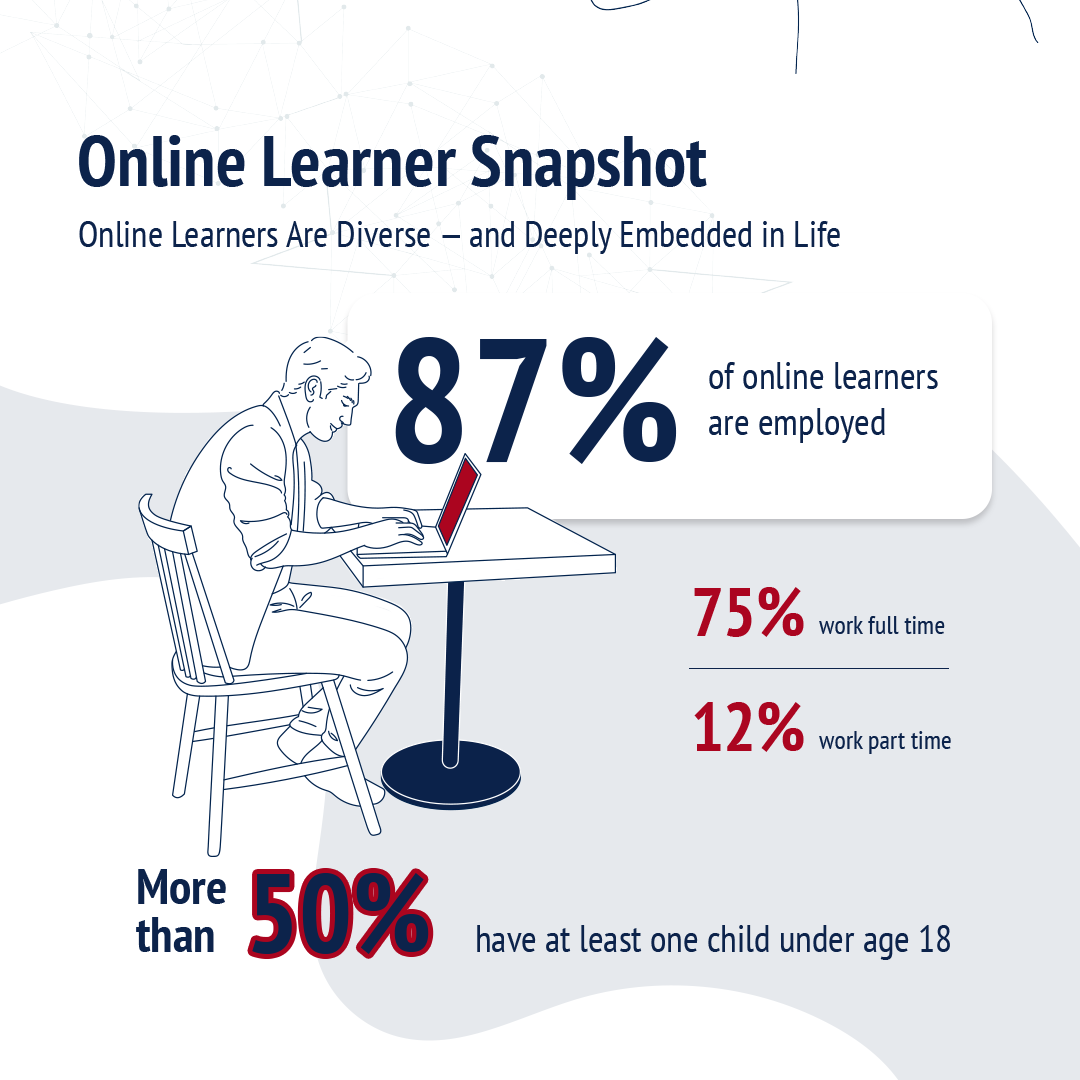
- 87% of online learners are employed
- with 75% working full time, and
- 12% working part time
This alone distinguishes the typical online learner from the traditional, residential college student. Online education is not primarily serving learners who are “between” life stages; it is serving learners who are firmly embedded in them.
Family responsibilities further define this group. More than half of online learners report having at least one child under the age of 18, reinforcing the idea that online education is often pursued alongside caregiving, employment, and household management. This combination of full-time work and family obligations explains why flexibility is consistently cited as a primary driver of online enrollment.
Career stage is equally central. The Online Schools Report describes many online learners as “career accelerators” and “career changers,” rather than first-time entrants to the workforce. These learners are enrolling with clear professional objectives: gaining new skills, changing fields, qualifying for advancement, or remaining competitive in rapidly evolving industries. Online learning is not an abstract educational pursuit for this population — it is tightly linked to employment outcomes.
Millennials make up a large share of this group, but Gen Z learners are increasingly enrolling online as well, particularly for skill-based education, credentials, and programs aligned with emerging fields. For younger learners, online education often complements early career exploration or supports strategic pivots rather than following a linear school-to-work pipeline. For mid-career learners, it serves to re-skill without stepping away from income or professional identity.
Industry diversity among online learners is broad, but the common thread is necessity: learners in healthcare, business, technology, education, and other applied fields often turn to online programs because they need education that adapts to demanding schedules, shift work, or unpredictable hours. In this context, asynchronous coursework and career-aligned curricula are not just preferences — they are prerequisites.
Today’s online learner is a working adult with defined career goals, active family responsibilities, and a desire for educational experiences that feel connected to real-world outcomes.
Online Learner Demographics Still in Motion
Online learner demographics continue to evolve as technology advances and learner expectations rise. Today’s online students are more diverse in age, gender, and life circumstances than ever before, united by a shared need for flexibility, relevance, and access.
Overview: Online Learner Trends and Demographics
The picture that emerges from today’s online learner demographics is clear: online education is no longer serving a narrow or temporary audience. It is meeting the needs of learners who are deeply embedded in work, family, and community life — learners who require education to adapt to them, not the other way around. From working parents and first-generation students to veterans, career changers, and younger digital-native learners, online education now supports a wide range of life paths and goals.
As these demographics continue to shift, the design and delivery of online programs must adapt as well. Flexibility, personalization, relevance, and strong student support are no longer differentiators — they are expectations. Online learner demographics may still be in motion, but one thing is certain: the future of education will be shaped by learners who demand access, adaptability, and outcomes — and online learning will remain a central part of that future.
Infographic