Key Takeaways
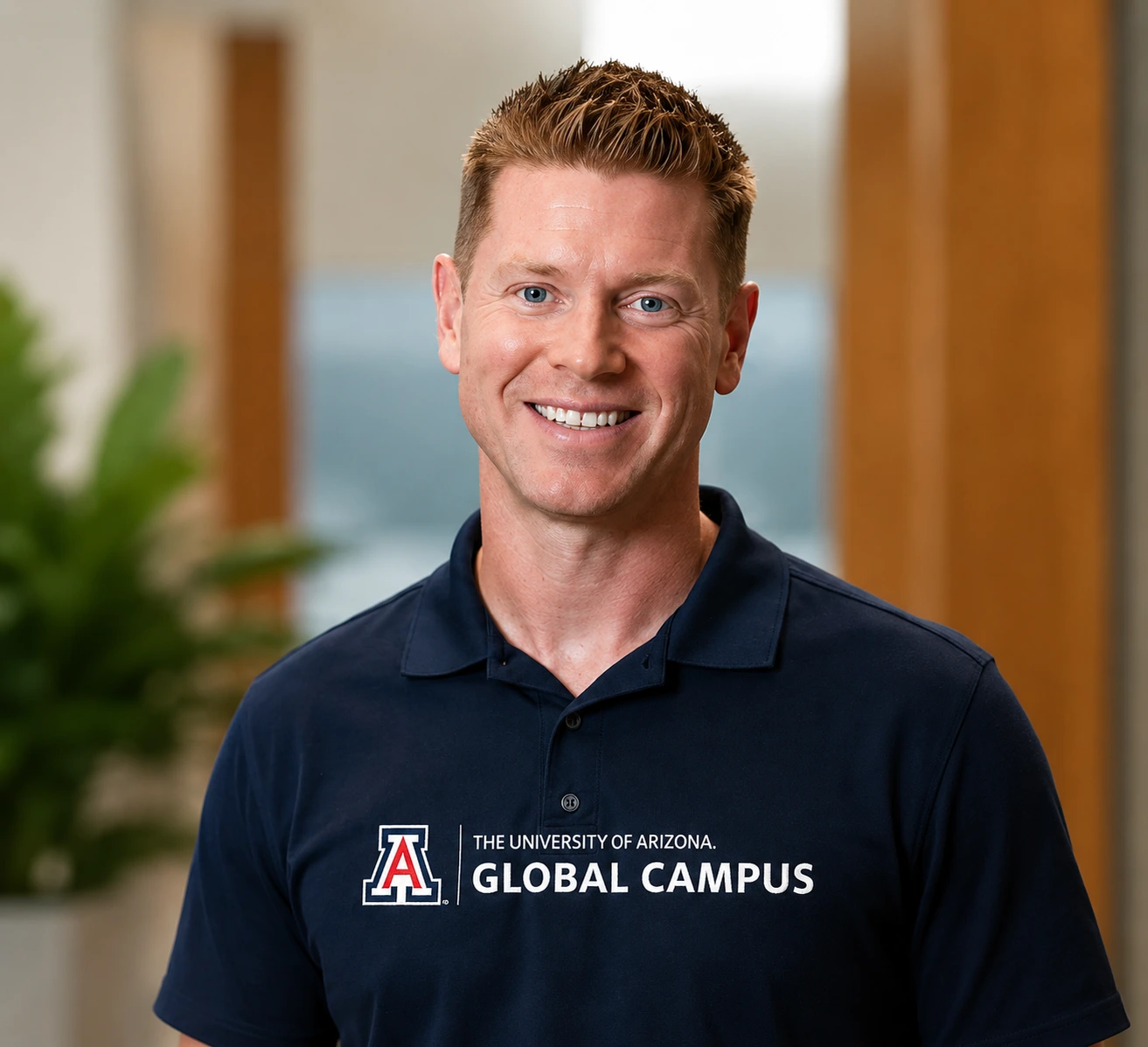
- In this blog, UAGC Program Chair, Dr. Heidi Linn Smith, shares insights on what students can expect from the Master of Professional Studies in Leadership program at the University of Arizona Global Campus (UAGC).
- The program is designed to help working professionals strengthen their leadership skills and apply what they learn to their careers and everyday decisions.
- Data, real-world case studies, and emerging technologies such as AI will be part of the learning experience.
- Students will explore the ethical considerations of using AI in leadership and learn to distinguish between appropriate academic and professional uses of AI.
- Students will reflect on their own strengths, areas of opportunity, communication styles, and leadership presence.
- Coursework builds toward a portfolio that documents students’ development throughout the program.
- The capstone gives students an opportunity to look back at their growth from their first course through their final course.
Getting to Know the Master of Professional Studies in Leadership: 6 Things to Expect as a UAGC Student
There’s a misconception about leadership that I wish would disappear: that you need to hold a certain title to be a leader.
I know that because I used to think that way myself.
Earlier in my career, I was a program coordinator. I didn’t really see myself as a leader. Later, I became an assistant director of programs, but even then, I didn’t necessarily think of myself as a leader because there was always someone above me.
Looking back, I can see that I was making decisions every day that were foundational to leadership. That’s where you build your skill set.
You may be doing the same thing right now.
You’re about to begin your Master of Professional Studies in Leadership program, and you may be wondering what to expect, how to prepare, and whether you’ll succeed.
Maybe you aren’t supervising anyone. Maybe “leader” isn’t part of your job title. But you may be the person people turn to when there’s a problem. You may be influencing decisions, coordinating projects, mentoring colleagues, or finding solutions when things don’t go according to plan.
Those are leadership skills.
This program will ask you to think more broadly about what it means to lead. Because the degree is interdisciplinary, leadership won’t be confined to one industry, one organizational structure, or one type of professional role.
Leadership is about people. It’s about decisions. It’s about influence, communication, trust, and the ability to move something forward. And there isn't one right way to do any of those things.
Below, I’ll discuss a few ways you can approach leadership and what you can expect from the Master of Professional Studies in Leadership program.
- You Will Become a More Intentional Decision-Maker
One of the biggest focuses of the master’s degree in leadership program is learning not only to think strategically but to think innovatively about how you lead and make decisions.
That means learning how to use data to inform your decisions. It means examining real-world situations and case studies. It means considering different perspectives before deciding how to move forward. It also means understanding the tools that are changing the way we work.
Artificial intelligence is an obvious example.
"Leadership is about people. It’s about decisions. It’s about influence, communication, trust, and the ability to move something forward."
If you haven’t already, you are going to encounter AI in your professional life. It’s already changing how people work, communicate, analyze information, and make decisions. None of us knows exactly where it’s going, but ignoring it isn’t going to make it disappear.
I think of it this way: It would be like knowing there’s a user manual available but deciding not to show it to you. That doesn’t help you.
I want you to have the manual. I want you to understand what these tools can do, where they may be useful, and where caution is needed. That includes being able to answer ethical questions.
What happens when technology begins influencing decisions that once required a distinctly human touch? What are the environmental implications? How do we maintain the human element of leadership while using tools designed to make certain tasks more efficient?
The goal is for you to feel confident enough to be deliberate in your problem-solving while also relying on your original thinking. We want to see your ability to analyze, synthesize information, ask questions, and make connections. Technology is your resource. It can support your thinking and decisions depending on when and how you use it.
As a student in the Master of Professional Studies in Leadership program, you’ll have an opportunity to explore those pathways, strengthen your ethical reasoning, and develop your own perspective.
- You Will Learn to Lead in a Changing Landscape
The world in which we lead has changed dramatically. We work from different places. We communicate in different ways. We collaborate across distances. Even some of our everyday interactions have become more digital. And that means leadership has to adapt, too.
You may find yourself leading people you rarely see in person. You may communicate with colleagues through a screen more often than across a conference table. You may have to make decisions with more information, and more technology, than leaders had access to in the past.
This program is designed to help you navigate that landscape. But adapting doesn't mean chasing every new trend. It means learning how to ask better questions.
What does this change mean for my organization? How will it affect the people I lead? What problem am I actually trying to solve? What information do I need before I make this decision? What are the potential consequences?
That kind of thinking is at the heart of intentional leadership. This program will teach you how to lean into flexibility during seasons of change and be a leader that your team can look to for steady ground.
- You Will Look Inward
Some of the most important work you will do in this program may have less to do with learning about organizations and more to do with learning about yourself.
Early in the program, you’ll begin reflecting on your own leadership skills: your strengths, your areas of opportunity, how you communicate, how you relate to others, and how you respond to challenges.
You’ll be asked to consider not just what you do, but how you do it.
How do people experience you?
What kind of presence do you bring into a room or into a virtual meeting?
How do you influence others?
How do you respond when someone challenges your thinking?
How do you recognize opportunities in yourself and in the people around you?
These questions matter because leadership is about more than processes and protocols. People may come to you with problems that don't fit neatly into a process. They may ask you to think differently. They may need you to see an opportunity they haven't seen themselves.
Your job as a leader isn't always to have the answer. Sometimes it's to ask the question that helps someone else find one. Your coursework will implore you to distinguish the difference by examining your own qualities through different scenarios.
- You Will Learn to Hold People and Performance Together
I believe effective leadership requires strategy and empathy. You need to understand the larger goals and make decisions that move an organization forward. But you also need to understand the people affected by those decisions.
Leadership isn't choosing between people and performance. It's learning how to hold both.
"Your job as a leader isn't always to have the answer. Sometimes it's to ask the question that helps someone else find one."
That means communicating clearly. Building trust. Understanding different perspectives. Recognizing the strengths of the people around you. And being willing to adjust when something isn't working. It also means being intentional.
Very little about leadership happens in isolation. The way you communicate, the way you make decisions, and the way you respond to challenges all contribute to the environment you create around you.
That’s why I want you to think beyond, “Did I make the right decision?”
Ask yourself: What did that decision create? Who did it affect? What did I learn? And what might I do differently next time?
Those questions will serve you well long after you finish this program.
- You Will Be Able to See Your Growth
One of the things I’m especially excited about is the way your work will build throughout the program.
In our Strategic Frameworks course, for example, you’ll work through a long-term case study that asks you to make and evaluate leadership decisions. You’ll analyze what worked, what didn’t, and what you might do differently. That work will become part of your portfolio. And that process will continue throughout the program.
By the time you reach your 10th course, the capstone, you’ll be able to look back at the work you completed in your first course and see how much you’ve developed.
I hope that moment is meaningful for you.
"Leadership isn't choosing between people and performance. It's learning how to hold both."
Your portfolio won't just demonstrate what you learned. It will tell the story of how you learned to lead. You’ll be able to see the evolution of your thinking, your decision-making, and your leadership skills. You’ll have tangible evidence of the work you’ve done and something you can carry with you beyond the classroom.
- There Is No One Way to Lead
If there’s one false impression about leadership that I want you to leave behind, it’s that there is only one way to lead. There isn't.
We all bring different experiences, perspectives, and strengths to the table. And making sure everybody has a place at that table is important to me.
You don't need to become someone else's version of a leader. You need to become a more intentional version of yourself.
That will take work. Graduate-level study will challenge you in ways that may be unfamiliar. Some assignments will be difficult. You may even receive feedback that makes you rethink your approach.
Listen to that feedback.
In fact, I would make this one of your rules for the program: don't ignore feedback.
Your courses build on one another, and the feedback you receive can help you develop the skills you'll need in the courses that follow. More important, learning to receive feedback, reflect on it, and apply it is itself a leadership skill.
And don't be afraid to reach out to your faculty.
"You don't need to become someone else's version of a leader. You need to become a more intentional version of yourself."
Learn from them. Ask questions. Let them challenge your thinking. Take advantage of the experience and perspective they bring to the classroom.
This will all help you to shape your unique style of leadership.
Your Leadership Toolkit is Here
You don't have to have everything figured out when you begin your program. You just have to be willing to begin.
My hope is that when you reach the end of this program, you’ll have more than a master's degree. I hope you’ll have a deeper understanding of yourself, a stronger leadership toolkit, a portfolio that demonstrates your growth and, most important, a clearer sense of the kind of leader you want to be.
I’m looking forward to seeing where you take it.
And if you haven’t yet enrolled in the Master of Professional Studies in Leadership program, I encourage you to reach out. Even if you’re not in a leadership role, what you learn in our courses can be applied in almost every scenario. Take a chance on yourself and invest today.